

The Disappearing Act
“Then, I felt deeply guilty for spending more time with imagined people than real ones. Today, I know I was just doing my best.”

THE NEW CRITIC
Milla Ben-Ezra is a 21-year-old writer and editor of The New Critic from Los Angeles studying English Literature, Anthropology, and French at Swarthmore College.
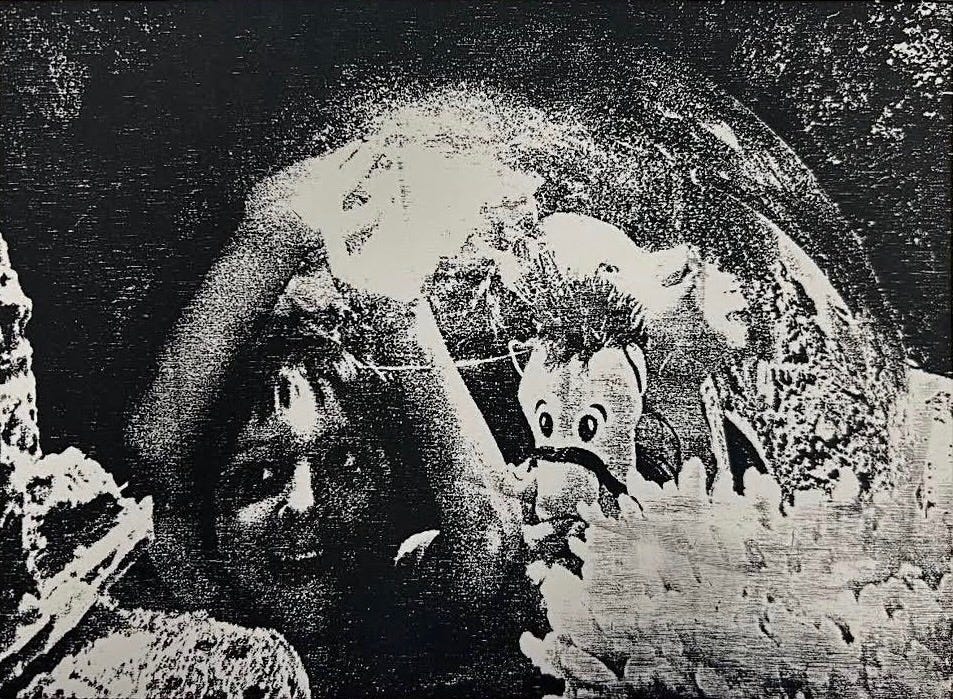
*In conversation with Tessa Augsberger’s piece “In Need of Daydreams,” Milla Ben-Ezra writes about her own peculiar relationship to daydreaming.*
At dinner, plates clutter the table with warm food. We play Tetris with ceramics and silverware to make room for the next dish. We pray, then we eat. The fullness of my stomach is rivaled only by the fullness in my heart; I am happy. Afterward, my mom and I watch my little cousin as she plays by herself in the backyard.
“You should tell her about your little friend,” my mom jokes. My cousin mumbles words to herself and smiles. My mom looks to me, waiting for a reaction. I laugh to make the conversation go away.
Confronted by recognition, I sink inside. That family metonym, “my little friend,” has become the only secret code, the only means to communicate a part of me kept meticulously hidden in small gestures, quick movements, and hushed giggles, tears, and whispers.
I used to cringe when any of my family members brought it up. Today, I only flinch a little. I’m still taken aback by the recognition of my chronic, perverse practice: daydreaming. Chronic, compulsive disappearing.
My cousin giggles in the distance. I watch her and wonder where the end of childhood begins — where it stops being normal to wander a backyard, enraptured by the world of your imagination.
Growing up in Los Angeles, I encountered every kind of so-called "crazy person." When I was young, I didn’t see housing, welfare, or institutional failings. Instead, I saw people crossing the street as they mumbled and laughed to themselves. At some point, at age nine or ten, I began to see them as ‘self-released’ from society. I was terrorized by the idea that I was destined for insanity.
I felt an odd sort of kinship with these marginalized and ‘abnormal’ minds — the ‘broken,’ the ‘lost,’ the entirely gone. I saw myself in them and so was deeply afraid that my tendencies toward insanity might land me alongside them, might cast me — publicly and shamelessly — as insane. I began to draw connections between their routines and my own mental solitude and uncanny ability to keep myself company by filling my mind with imagined characters and places.
I began to fear, more than anything, that I might face the same fate — that one day, my mind might satisfy me more than real social interactions did, more than societal constraint and expectation. That I would be so seduced by fantasy and disappointed in reality that I might choose to escape, choose to live in a world of my own creation. I believed it wasn’t a matter of if, but when.
“Going crazy,” I respond to my first therapist when she asks me my biggest fear. “I’m scared one day I’ll lose my mind.” I don’t tell her what that means. I don’t tell her losing my mind means losing sight of the world, losing everything but my mind.
As a child, I took my pink Razor scooter and glazed the backyard in rubber circles. Rounding over bumpy corners, I’d kick the deck in circles around the bar, hitting my ankles, bruising my feet. Talking to myself, dreaming. One time, I slammed into a wall, ripped off my toenail, and broke my pinky toe. I was woken up, as it were, by unbearable pain in my foot.
When I was a teenager, I took a deflated basketball and kicked it repeatedly against a half wall tiled in stone. Here and there, I’d flick the ball into my hands and send it toward the hoop we kept in the backyard for my sister to practice on. I liked it better on the edge of the backyard. It was far, and I could face the hedge. My parents wouldn't be able to see my lips move or my face contort with laughter. I knew they were suspicious of my odd behavior, but I felt that if they never caught me — or rather, if I never caught them catching me — I'd never have to face the shame of my secret. I wonder how many hours I spent out there, kicking a ball back and forth, completely dissociated from my physical reality; living, instead, in my mind.
The pandemic hit when I was fifteen, and for the next two years of my life, I was relegated to solitude. I had no friends at school, no real ones that loved me. I had nothing I cared for deeply, nothing in this life that felt worth living for. I wanted time to pass, and I wanted it to pass quickly. We learn at a young age that we are not in control of how time moves, of what our lives look like, existing in that uncontrollable network of numbers and tasks. I was more unhappy than I knew possible. I wanted so much and felt that I had so little.
So, I disappeared. One hour became four. Four hours became more.
I’d log onto Zoom class and log off after fifty-five minutes of playing slither.io to the rhythm of precalculus gibberish. I’d go outside and disappear. An hour later, I’d log back into class and log off. I’d disappear. I’d log into dinner and texts, Facetimes and virtual activities. I’d log into my world, and then, when my duties as a student, daughter, and human were fulfilled, I’d log back off and disappear again.
The pandemic was the first time in my life — not by choice but by opportunity — that I spent most of my waking life in daydream. There was little keeping me tethered to the ground; few plans, few scheduled commitments, few eyes gazing down my back. I had the space and time to do it — my days, like my conscious self, disappeared into fantasy.
When I wasn't invited to a party or a crush didn’t like me back, I spent my Saturday nights with the ball, kicking it back and forth against the wall, hanging out with my other friends, my other crush, at a party I threw in my mind. When I felt small in this world, I felt big in my own. I felt important, loved, and respected. It also felt more real than the world I was stuck living in; I felt more invested in the relationships I made up than those which had failed me in real life.
I questioned, from time to time, my sanity. I wondered if it made me insane, by default, if more often than not I was in my own realm — that normal people daydream sporadically and that I, on the other hand, was sporadically coming out of daydream.
Then, I felt deeply guilty for spending more time with imagined people than real ones. Today, I know I was just doing my best.
My house was never a quiet one, and we always had guests — family friends, uncles, aunts — living with us in rotation. Long before the pandemic, at about twelve, I started to feel it was time to hide my other self. I couldn’t bear the idea that someone other than the four members of my family, who were stuck loving me, would know that I was insane. That even after childhood, I acted like a child. That I was fundamentally broken in the head. That I wasn’t normal, but abnormal. Not active, but overactive. Not here, but there.
The shame I felt was twofold. First, I was afraid of the simple fact of discovery — afraid of being known as different or weird. Second, I was afraid of being overheard. Unlike the typical mind that houses the extent of one’s imagination, mine had leaks. My thoughts and imagined world seeped out of their comfortable home inside of me and joined, despite my massive fear of dogmatic social judgement, the external world.
Like everyone, my inner world is the most intimate space in my life. Yet, my interiority is in forced conversation with exteriority. Daydreaming is my subconscious coming alive, it is a submission to my deepest, blurriest desires. It is dirty, real. It is fantastical, egotistical. It is everything I could ever possibly think to want. Even today, when I can talk about the act of daydreaming, I could never betray their contents.
Being discovered through being overheard continues to be a fear of mine. Continues to dictate, on the most fundamental level, how, when, and where I daydream. Daydreaming, as a result, is shaped by reality and serves to resist it — one of many paradoxes this habit confronts me with. My daydreams are both internal reactions to external happenings and simultaneously, in the private craft of a world or moment, one of the few ways I fight against the harshness of the world around me. My deepest dissatisfactions with real life control this space — a space just 'for me.' My imagined world both shelters and enfolds the collective around me. My daydreams are shaped, fundamentally, by the actions of others. Yet there, I feel no fear of repercussions or judgment. Unless, of course, someone finds me out.
Immersive daydreaming is both regulated and unregulated. It’s set in time and space, set up by my conscious musing, but it’s taken somewhere foreign, somewhere unexplored, somewhere new. I determine the parameters of the story, but the characters (myself included) dictate the so-called plot. I don’t go into a dream planning to cry, and still, sometimes I leave wiping tears — tears whose origins are both known and unknown — off my face. I’m aware and unaware. I’m here, and I’m there.
In this duality — the complete surrender to interiority that causes both clarity about and distance from reality — comes the shame. If I were dreaming of things which had no relation to myself, I’d likely care little if other people discovered the nature of my daydreams. But if what I dream of were to be revealed, I’d feel as though my skin had been turned inside out.
There is a real difference between a daydream — a brief period of imagination and wishful thinking, or for the anxious, of lamentation — and an immersive daydream. Immersive daydreaming is commonly accepted as a daydream that lasts over thirty, uninterrupted minutes. Oftentimes, these daydreams involve intricate storylines, repetitive physical behavior (like listening to music or, in my case, riding a Razor scooter in circles or kicking a ball back and forth), and are for the most part, all consuming.
It’s hard to describe what immersive daydreaming actually feels like. However, the instance when it ends is a bit easier to pinpoint. It feels like coming-to when a teacher calls on you in a lecture to which you weren’t paying attention. It feels like a car honking behind you when you’re on your phone, and the light has turned green but you’ve forgotten altogether that you were driving, consumed by a world on your screen. It feels like waking up in the morning, like knowing you’re awake and that you were, until now, asleep, but you’re not sure where the sleep started or ended, precisely. So then, falling into a daydream becomes a sleepless end to consciousness. It's a fading out, a rope connecting realities, slowly fraying.
Still, there is a distinction to make between immersive daydreaming — which was obviously what I’d been doing for my entire life — and maladaptive daydreaming, which I had come across in a Google search toward the end of 2022.
When I turned adult, I moved across the country for college and, for the first time since I was ten, did not have my own space. The shame of being stuck between real life and my secret world followed me, becoming a creeping anxiety: What would I do if I could never be alone with myself? What would my roommate think if she caught me?
I fell in love for the first time toward the end of my freshman year of college. I felt cherished and appreciated, seen and cared for. I had friends and a girlfriend. I had a job and classes I was interested in, professors I looked up to. I felt accomplished and ambitious. I had everything I dreamed of as a child. Still, I disappeared. Still, I imagined myself with other people, in other places, doing other things. It’s okay to dream of someone else, it’s okay to fantasize and have small crushes while in a relationship. It isn’t, however, okay to live — in mind and spirit — in another reality with other people in other places doing other things. It wasn’t only that I felt like a cheater. I felt like a liar too.
How can I lie in bed with someone who feels they know me and have another world, to which I am equally (if not more) dedicated to, living inside of me? What does intimacy look like when I keep half my identity hidden from the people I love?
By then, I had tried stopping many times. Later, I’d learn that trying to stop is like quitting an addictive drug. As a tween, I told myself I’d stop when I got my period, when I became a woman. In high school, I decided I’d stop when I went to college. Of course, I didn’t. And at school, when I’d come to — facing myself in the dorm mirror — I no longer saw a girl crippled by severe dissatisfaction with her own life and accomplishments and relationships; I saw a happy young woman, accomplished and well-connected, still stifled by a bad and embarrassing habit. I saw a child playing pretend. I saw a woman, stuck. A woman, broken. I wanted to change. I wanted to quit, for good.
Maladaptive Daydreaming Disorder. MDD. There are few that research it, but I found a professor who offered a private practice. At first, I scraped together the $150 session fee myself, not wanting to remind my parents that they raised a broken adult — unable to go to school, do her homework, see her friends, and be satisfied. Eventually, I started consistent therapy sessions in the spring of 2024, financed by my parents. They had watched me spend half my life talking to “my little friend” and were eager to break ground on finding a fix.
First, the professor asked me why I wanted to stop. “Many people see it as a gift, as a special power. Why would you want to get rid of it?” I could tell he was testing me — testing if I was really committed to his process.
“I feel ungrateful. It makes me feel like I can’t be happy with the life I have.”
The professor was methodical, not overly soft or cautious like other therapists I’d met with. He didn’t make me talk about my feelings, about the voids I was trying to fill — though once he made me explain the main plotlines of my daydreams, which I hated doing. I avoided details to keep the conversation from sinking too far beneath the surface. I wasn’t coping with trauma, like many other MDD patients. Instead, I was a girl with an overactive imagination that had lost control. I was a girl concerned with whether or not ‘high-functioning’ was functioning highly enough. I was a girl who needed help, desperately, for a problem whose origins she couldn’t place, whose cure she knew deep down didn’t exist. But still, help was help.
The professor was interested in tracking my habits. We charted the times of day, the durations, and the details of what my daydreams looked like when they occured.
I found this very difficult. I scribbled in the chart minutes before our appointment so I had something to show for my efforts. At school, I didn’t have a space to centralize the facilitation of my daydreams. I couldn’t set a timer that ended three minutes before Zoom class started. I couldn’t track when I disappeared and when I came back. I made up the numbers to the best of my ability. One hour here, one hour there.
The professor made me write down phrases to repeat like mantras, to use when I felt the nagging urge to check out of reality. He suggested a few examples, all of which I found jarring. I struggled to make my own, though the point was to speak them in order to bolt my feet down to reality.
His recommended phrases were sharp, framed around buzzwords meant to inspire fear:
“I don’t want to waste my life away in fantasy.”
“I will release myself from the grip of fantasy.”
“I don’t want to be a daydreaming junkie.”
The phrases I crafted led, instead, with sorrow and self-pity:
“I love the life I have.”
“I’m losing gratitude for all that I am grateful for.”
“I don’t want to have this embarrassing secret to keep from my loved ones.”
“Reaching for something that is not mine makes me unsatisfied.”
Then there were other phrases I made up — I can’t recall whether or not he approved of them because he was particularly choosy about which of the phrases would be most effective. The power in these mantras was rooted in shame and embarrassment, phrases like “I refuse to look insane.”
And then there was one which unified my affectual realities: “I refuse to lose gratitude for what’s real.”
I think I struggled then with feeling dissatisfied. I felt guilty that my newly perfect life wasn’t perfect enough for me. That it might never be enough to keep me tethered to it.
By most measures, the therapy was helpful. I had language to describe something that had long evaded description. I had a real-life human being who told me with real-life words that I wasn’t insane or broken. Still, the whole process affirmed I was abnormal, overactive, disordered. I told my friends I was in “special” therapy. When they asked what that meant, I said it was complicated and didn’t want to talk about it.
The therapy reduced the sheer amount of daydreaming I engaged in. It also gave me the tools to choose an alternative, to recognize when I was daydreaming in order to pass time or to dilute icky feelings. It gave me a framework through which to craft my own perspective, a lens through which I might understand daydreaming anew.
Yet, the treatment itself — the endless grids, lists, and strict phrases — felt like it was missing the mark. I slowly lost interest in trying to contain my daydreams. It felt futile, like trying to capture a cloud with a net. I had grown tired of sharing my inner life. I lost pieces of my privacy. My collection of “only-me” things was being chipped away, and the immediate return wasn’t worth sacrificing all that.
What I see now is that this choice to end therapy — and to work through this issue myself — signals a deep love of self. The presence of nobody in my daydreams bloomed this imagined space into an oasis of regeneration, self-sustenance, and care. I felt that letting the professor in to my inner world polluted the oasis — his immediate presence brought with it his own judgements and psyche. I wanted my world to stay disentangled from his. For this, I was willing to quit quitting.
The therapeutic process felt like an oversimplification of something that was growing increasingly complicated. I was now a ‘real’ adult, reminded that this habit was something real adults don't do. Yet, as I became more conscious of my relationship to daydream, I was able to see clearer and reframe, finally understanding it as respite.
Daydreaming is my panacea. When the world lets me down, I’ve crafted something reliable, something that is mine alone, to pick me back up. What I got from therapy was an illumination of language and a slow release of the shame I dragged through my entire life. From this emerged an acceptance that daydreaming was, just like the rest of reality, out of my control. Some things about ourselves, even the burdensome things, should not be done away when the cost of losing them means losing some fundamental part of who we are.
I told a friend about my other life for the first time shortly after quitting therapy. She reacted the way a mother might to her flamboyant son coming out as gay. I’m not surprised, her face read. Not surprised. And still, she loved me.

THE YOUNG AMERICANS
Beautiful and candid piece, Milla. You have an incredible voice as a writer and admirable courage for sharing something so vulnerable. Of course, the piece is deeply personal, but the message of accepting and working on parts of yourself on your own terms is a resonant one.
Could read your writing all day :) thank you Milla