
Those Halcyon Days
“What can possibly explain the triumph of trauma in modern discourse?”

THE NEW CRITIC
Dylan Partner is a 22-year-old writer who recently graduated from Georgetown University and now lives in New York City. He writes at The Complaint.
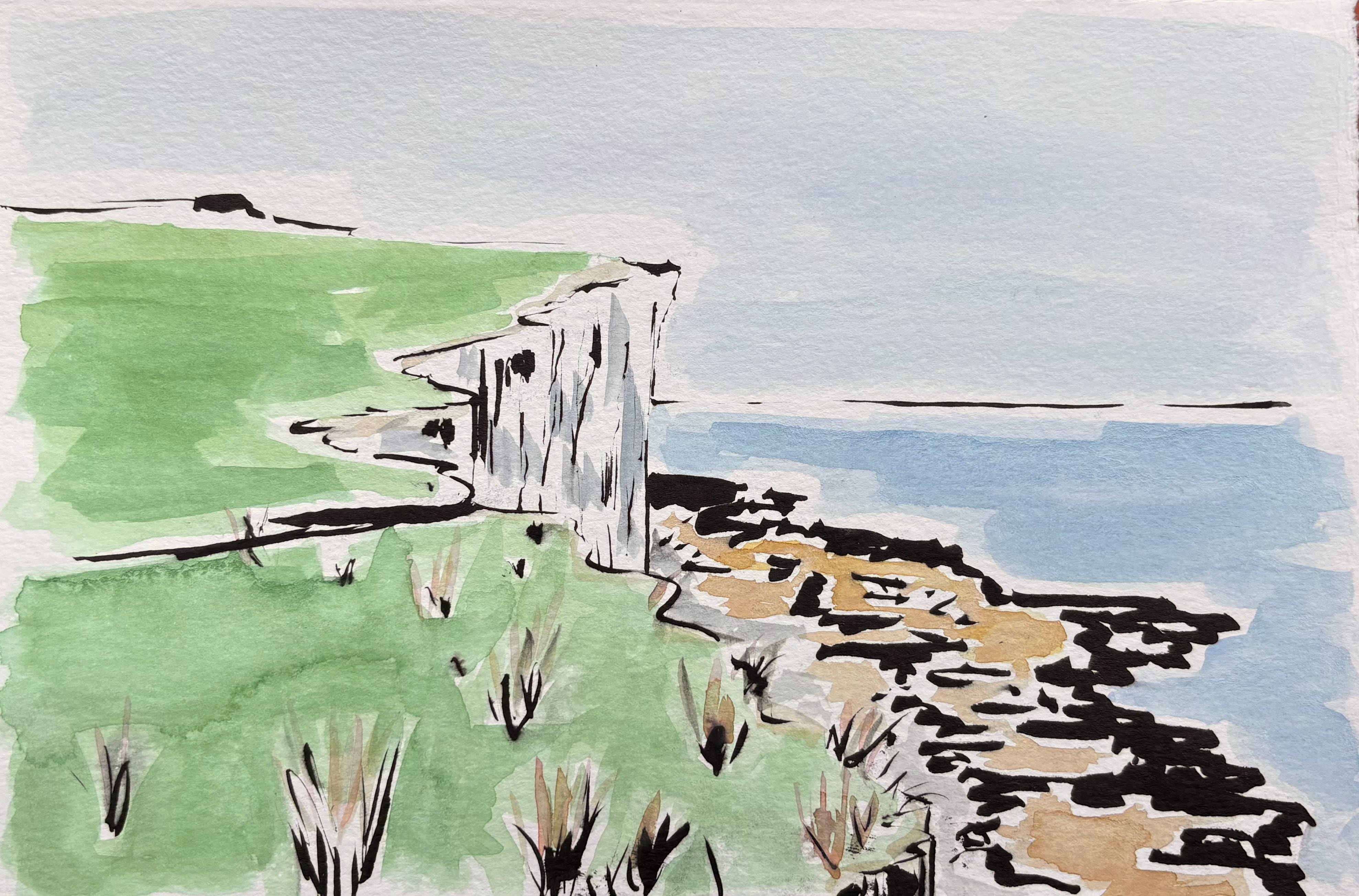
Towering over the waters off the southwest coast of England, the great White Cliffs of Dover are mass graves for microscopic plankton called coccolithophores. Over geologic timescales that render the span of each brief coccolithophore life even more fleeting than it already is, their shells accumulated at the bottom of the sea, stacking upon each other until the seafloor was coccolith, up to 1600 feet of calcified coccolith, a mountain’s worth, and the remains of those that more recently died compressed the skeletons of the long-departed until they became chalk. Then, as the Earth’s tectonic plates were rent, the seafloor rose up into the British sky and was garnished by a layer of grassland, where tourists today try on cloudless days to catch a glimpse of the French shore while Exmoor ponies graze nearby.
But if you brought a sufficiently powerful microscope to the County of Kent, you could see the fossilized coccolithophores still preserved in the cliffs as distinguishable individuals; they look like tiny spheres of sand dollars. Each one was once, several tens of millions of years ago, alive for a handful of days in the late Cretaceous ocean. Each was an evanescent thing that has been made more beautiful by being tiny and ancient. The coccoliths — the shells of coccolithophores, warped by time and mass movement, but still recognizably themselves — built the White Cliffs of Dover, if not through any force of their own.
Were you conscious in 2016? Do you remember the steady drumbeat of loathing for that year while it happened? Sure, all the hymns of hate added up to little more than inane frustration with celebrity deaths, a spate of evil clown sightings, and Donald Trump’s ascension to the American presidency, but between the Telegraph pondering whether it was “really one of the worst years in history” and John Oliver’s cringeworthy pyrotechnic demolition of the year in effigy, 2016 still stands alone as a peerless object of disdain in popular culture — especially after 2020, when, perhaps for the first time in our lives, our generation came to know what it actually feels like to live through a span of weeks where decades happen.
Even so, it was jarring when I recently came across a meme that presented the essence of life in 2016 as a pastoral idyll of sunshine and sunflowers. Did the meme’s creator — or any of the 20,000-plus people who liked it — remember the zeitgeist, or were they too young then to have assimilated the prevailing discontent? Were they too embarrassed to admit they partook in those world historical histrionics? Or was the discontent always simulated — was it only a playful hatred, signaling little or nothing about the mental states of those who engaged in it, whose superegos successfully policed the no-man’s-land of ironic distance between outward expression and inward belief that makes so much online speech utterly bereft of meaning?
Each of these explanations has its truth; after all, there’s no reason to believe that any two people experienced 2016 in the same way. But they all sit under the shadow of nostalgia, the broader phenomenon at work here: existing purely unto itself, outside of history, as an artifact of the arc of human development, nostalgia’s universal recollective grammar is seeded into every soul. Nostalgia pays no heed to silly ephemeral constructs like “2016,” even as it leaves false realities of its own in its wake.
In the paper in which the teenaged Swiss medical student Johannes Hofer coined the term “nostalgia,” he explains his neologism is meant to “define the sad mood originating from the desire to return to one’s native land.” He wrote that sentence in 1688, well before the steam engine provided an unprecedentedly efficient means by which one could leave their native land on the rails or the roads and, perhaps only incidentally, the power to subject that native land to creative destruction several times over in the span of a single human lifetime. In the modern age, it is easier than ever to feel displaced without moving in space (modernity has proffered many technological remedies to all this displacement, though they hardly suffice as compensation). So, with respect granted to the precocious Hofer, nostalgia is too small a word for all that it represents, and I’d like to elucidate the distinction between two overlapping but unlike tendencies that go by its name.
The first tendency is the mourning of bygone naivete, lost worlds of our childhoods (any worlds we once inhabited, really, no matter our age), and the seemingly unmediated ways we could once orient ourselves in those worlds before mental entropy muddied our souls — entropy being the irreversible thermodynamic process whereby simple things become more complicated.
Though we were likely attuned, to an extent, to the realities of our youths while we lived them — recessions, divorces, deaths, household and worldwide strife don’t go without notice in the childhood mind — the act of nostalgia can obscure this. Instead, the neural invisible hand beckons us to imagine a halcyon all-encompassing innocence, its totality bolstered by our present cynicism, which, if extensive enough, submerges our soul in viscous black tar, and makes idealism feel even more impossibly inaccessible through engagement with the world as it is, rather than the reconstructed world of the past. Even idealists easily find refuge there. It is no wonder, then, that one can become lost in nostalgia, and upon burr-stuck emergence from the forests of memory, feel nothing more than the overpowering will to return. This sentiment seems so natural that we rarely stop to consider the mental processes by which it emerges.
Existence in the present is overwhelming, even though our brains work tirelessly to simplify it. In moment-to-moment life, all that we receive from our eyes and ears and fingers gives us the perception of unmediated experience, but philosophers and psychologists alike know well that this is just an illusion. Our vision is limited by our field of view, lacquered over at the blind spot, bounded on the electromagnetic spectrum, and blurred beyond the focal point. Even our comprehension of what overcomes these limitations on sensation is the end-product of a thousand more heuristics and simplifications. The world simply presents too many pieces of information for a finite and carbon-based being to handle, so our bodies, built by natural selection to economize, filter and patch and distort until they produce our shorthand experience of experience, which is somehow still baffling enough to keep all those philosophers and psychologists in their jobs.
As we learn and grow, existence only becomes more elaborate. Maturation, in the modern cliché, is the process of finding oneself — defining and refining one’s self-conception — through introspection, education, and peer interaction, all of which are lent a hormonal gravitas by adolescence. But parallel to that evolution is the maturity that emerges from placing oneself in relation to the world: extending the bounds of proprioception from tactile things like family, friends, and surroundings to invisible, or at least hard-to-fathom, things like geography and history that are built on interactions between many natural phenomena or mental states. Parents, authorities, and the principles they have imparted all lose their certitude thanks to this critical turn. “A single instance of mendacity in teachers or parents will inevitably make the young turn a distrustful and thus a sharper eye on their surroundings as a whole,” writes Stefan Zweig of his own coming-of-age in fin-de-siècle Vienna in The World of Yesterday. The falling-of-scales he observed then is just as true more than a century later and an ocean away. Starting one day with the epiphany that a third grade teacher doesn’t live at school, or that dad doesn’t really have eyes in the back of his head, one spirals from there, finding new depth in people and things and ideas in a hundred dimensions while the enchantments of youth darken.
Perception blossoms as we grow, while our pasts recede ever further into the fog of memory. The minority of moments we do remember are pared down and made vague in the mind’s eye. The brain is a lossy database: words once spoken, things once seen, thoughts once clearly held in our heads lose the precision they had in the instant of experience. They then meld with the interpretations we or others give them when they’re recalled, so that we sometimes literally cannot distinguish truth and conjecture. Paradoxically, this means the fog of memory can lend false clarity to our pasts by sanding off their rough edges and building a narrative coherence that never existed in its own time.
These forces — the immediate complexity of experience, the mental effects of maturation, and the narrativizing power of memory — go a long way toward explaining why nostalgia is such a universal human experience, particularly in modernity, as noted earlier. As the modern age is a particularly political age, nostalgia often forms a protopolitics, an understanding of oneself in a social context that is often directed towards stewarding the return of a personal prelapsarian Eden — a stance that is almost tautologically conservative, if not outright reactionary in nature.
Protopolitics can only be made into politics by force of collective action, or at least collective consciousness. In a 2007 essay, Svetlana Boym distinguishes between “reflective” and “restorative” nostalgias, which center the act of longing itself and “transhistorical reconstruction,” respectively. The former recognizes the insurmountable gap between what was and what now is; the latter seeks to bridge it, tut-tutters be damned. But I see another dichotomy in terms of individual versus collective nostalgia: the latter describing how nostalgia can break from the memory of whichever person or group from whom it originates, in a sort of memetic mitosis, and float freely between people of any age or experience until it settles again in a general “cultural memory” as a received truth. There it can be, at least implicitly, a bona fide ideological viewpoint: a protest, however inchoate, against what has changed.
And boy, can it be inchoate. “Never forget what they took from you,” is a popular resentful turn of phrase for the online reactionary, but it has been deployed so often in trivial or absurd ways that you are far more likely to encounter it being used ironically than otherwise. The posts I linked to above use it tongue-in-cheek, though it’s clear that their authors are truly lamenting a lost “what” (often a design aesthetic, product, or store that was culturally dominant in their younger years) stolen by an unspecified, malevolent “they” (determining “their” identity is an exercise left to the reader). “The world you grew up in no longer exists,” is another example of this earnest-by-occlusion phenomenon, where nostalgic images of discontinued game consoles and Taco Bell value meals serve as synecdoche for lost social orders. Again, this can be taken too seriously: modern online irony, when deployed successfully, puts political speech in a quantum superposition between jest and sincerity.
If true beliefs can indeed be delicately excavated from behind these unserious facades, they should be emblematic of collective nostalgia: dwelling on shared, context-independent lodestones of the past as an argument for political change (“RETVRN!”). But while these posts typically seize upon the living memories of their readers, there’s nothing about collective nostalgia that necessitates that the memories are living.
Possibly the most pervasive and enduring subject of collective nostalgia in the United States are the 1950s, even though the vast majority of people who commemorate them today never experienced the decade themselves. Someone who was ten in 1955 turns eighty this year, yet Gen Xers and Zoomers alike fondly “recall” the single-income suburban prosperity of the postwar period in the same rhetorical vein as those incanting “never forget what they took from you” about things they experienced firsthand in half-remembered childhoods and adolescences. As the first full decade after World War II, the Fifties manage not to feel unapproachably distant to those of us who never lived them, even as they grow more distant and thus ever-more susceptible to overbroad, collectively nostalgic generalizations. At least for now, they will remain America’s blessed childhood.
Wait! Wait! yells the liberal who started running towards us, a messy binder of charts and statistics in his hand, as soon as he overheard nostalgia about Baby Boom-era Americana. The Fifties actually sucked! And if you take a moment to examine the data he’s got while he catches his breath, you might come to think that he has a point.
Indeed, that pastel-colored nostalgic vision, built off so many magazine advertisements retrospectively reinterpreted as true scenes of daily life under Eisenhower, is deceptive. Americans in that decade were poorer than we are, had access to fewer basic technological amenities and utilities, lived in smaller houses, et cetera, et cetera…and that’s not to mention the achievements of the Civil Rights and feminist movements of the 1960s. But the subtext of collective nostalgia for the Fifties is often an indictment of those very same movements — the male-headed, single-income nuclear family in those advertisements is meant to be seen as something wrongly wrenched away by “them,” or at least lost in the great individualist morass and therefore unable to be rebutted by appeals to increased house square-footage. The nostalgists’ contention is primarily social, not economic. Yes, their appeal is partly based on racial and gender backlash, but these issues cannot be separated from the yearning for deeper purpose and social order that the nostalgia signifies, however mistakenly.
Some liberals and leftists have attempted to punch back on this turf in the awareness that they must contest Fifties nostalgia by confronting — perhaps you could say problematizing — the premise that then was a more existentially satisfying time to live than now. The paradigmatic example is this meme, which has received no fewer than 205,000 likes since it was posted in 2022. It overlays a happy-looking nuclear family with captions that testify to their hidden pathologies. “I can’t get through my day without a shit ton of drugs,” thinks the smiling wife. “I’m not allowed to wear pants or go to college,” counters her daughter, glass Coca-Cola bottle in hand. The Fifties, it seems, were psychologically bleak; any supposed tradeoff between economic and social progress and life satisfaction we’ve experienced since then is completely spurious.
You could call this rhetoric anti-nostalgia, and that’d be suitable enough to describe many works in the genre, but the message here is more than an advisory to think of the past without blinders. Rather, it positively urges readers to invert nostalgia altogether by imagining a fundamentally repressed and troubled society where every idyllic man and woman harbors horrific skeletons in their closet, taking real problems and exaggerating them to the point of historical anachronism. In short, to rebut collective nostalgia, such rhetoric constructs a holistic vision of collective trauma.
Trauma (I speak of the term here in its popular, non-clinical sense, which has moved beyond denoting the aftereffects of direct physical or physiological trauma to those of a broad array of interpersonal slights, deprivations, and childhood grudges) has already become such a central concept in cultural and political discourse that it has inspired backlash and a response to that backlash in the nation’s most prestigious magazines. But no matter however many essays are written against it in The New Yorker, trauma is here to stay: in the pages of literary fiction on the bestseller list, in the banal therapeutic language of our generation, in today’s deprived quasi-political approach to confronting ancestral wrongdoing. It’s a recourse in apologies (“Sorry, that was a trauma response”); a shallow addition to the introspective toolkit (“Maybe I do that because of trauma?”); and a throwaway descriptor of unpleasant experiences (“That movie yesterday was lowkey traumatic”).
What can possibly explain the triumph of trauma in modern discourse? I think it can only be understood as a progressive response to the inherent conservatism of nostalgia, as a blessed memory of the subaltern put in counterpose to nostalgia as an artifact of privilege, a way to construct oppressed identities for inhabitants of an era in which crude identity-based definitions have won out over other signifiers as a means of translation between individual and collective experience on the left. But trauma is not just the personal made political; it’s the personal and political mashed into a fine pulp. Every bit of individual trauma can constitute a politics, just as much as the long-ago collective traumas sustained by one’s ancestors can seep down into all aspects of their life, through nominally scientific or mystical means, and graft them into an overarching narrative of social injustice. See, for instance, the therapeutic phenomenon of “ancestral healing,” which stakes a loose claim to legitimacy via epigenetics (a legitimate field of study that has been chronically misused by trauma enthusiasts), but nevertheless quickly descends into the shamanic realm, uniting politics, psychology, and the numinous in a holistic worldview.
The traumatic framework thrives on the premise that, if only our pasts are examined thoroughly enough, demons lurking in the margins will manifest themselves — demons that must be thoroughly flushed out (unlearned, decolonized) if we are (as individuals or as collectives) ever to reattain the ideal health of the un-traumatized soul that the vicissitudes of life have denied us. Almost all of us have indeed been victimized before — some individuals and groups much more so than others — and this victimization can have long-term negative consequences for our self-conceptions and wellbeing. But much as nostalgia motivates the will to return, the traumatic framework urges its practitioners to insatiably move forward, through the destruction of friendships or political institutions, because the seed of persecution lies within all past relations. The framework heeds no call to remember the eternal fallibility of man or the productive capacity of those things it seeks to demolish. Our sins, our collective pathologies, will be wiped away in Year Zero.
None of this is to say that the traumatic framework is wholly without value. Trauma and nostalgia are both lenses that refract the complexity of experience through perception and memory until they’re concentrated in a mote of sentiment. Lenses can help to show us beautiful, true things, but if the lenses in our eyes are malformed, they cause astigmatism. If we don’t receive the right corrective prescription, the lenses in bifocals are more likely to blur our vision than to sharpen it. The fact remains that no matter how clear our vision seems, we’re only seeing through the looking glass.
“The past is a foreign country,” goes the old cliché, but no visa can grant us entry to it, and it grows further away with each day. So how can we ever understand ourselves or the world around us, given that no one denies the formative role of the past, in some sense or another?
One of the great purposes of education is to move one’s perspective outside the radically subjective realm by encountering the testimony of the unfamiliar world. The past opens itself for examination through memoirs, monuments, monographs, newspapers, novels — so long as we push our egocentric preconceptions to the wayside, at least for a while, and wander off the beaten path of ideology. Similarly, but on a far more intimate level, we open ourselves to productive introspection through a willingness to disrupt the convenient narratives we’ve built from the material of our pasts to undergird our self-conceptions.
No strange alchemy can resurrect that material. The many lived moments that have come and gone in our lives — the calcified coccoliths that constitute the White Cliffs of our present selves — will never be lived again, no matter the incantations said over their remains. Our selves are more than the sum of our experiences; we have been shaped and weathered and skewed by ineffable forces beyond the grasp of mere memory.
This takes away none of the beauty of memory, but it alone cannot mend our alienation from ourselves or the world. Neither the warmth of the nostalgic mindset nor the pathologizing force of the traumatic mindset brings us any closer to understanding the temporal foreigners who haunt our minds and our politics. We can only understand them when we finally recognize them as equals.

THE YOUNG AMERICANS
 | A guest post by
|
This rocks
Very interesting topic. On the image of the lenses of nostalgia and trauma is that analogy consistent with your previous framing? Nostalgia as you present it (I think rightly) with the idea of smoothing over past memories and filling in gaps to match present understanding of the events or times to which they relate is a subconscious process which occurs before recollection and is weakened by examination. In this way it is similar to the idea of receiving a changed image through bifocals. Trauma, as you say, is born out of “examination” and so is more akin to shining something through a prism and is an active and conscious process. Moreover nostalgia is shaped by many factors, perhaps most prominently the way in which we understood whatever is the object of the nostalgic feeling at the time and now, and how we now understand who were were when we first understood it. These considerations, especially the last are particularly eisegetic and therefore the one experiencing the nostalgia is more agent in its form even if the process is subconscious. Considerations of causes for trauma are often rooted in historical or contemporary events and as such are more exegetic, even if the process of their discovery is more active. As such it is hard to see as equals, or at least without more justification? Very sorry if I’ve misunderstood your point and have as a result misrepresented your argument here.