
In the Beak of the Heron
“I thought that if social life was confusing, isolating, and fearful, then the natural world, the world that could be walked and seen, would provide glimpses at the opposite.”

THE NEW CRITIC
William Diana is a 23-year-old writer currently living in Washington D.C. He graduated from the University of Virginia, where he studied Sociolinguistic Anthropology. He writes The Hermit Speaks.
This was when I was a university freshman, never mind where, when I spent vast amounts of time alone at night walking the streets of the small city that existed just outside the dizzying orbit of the university campus, like a small celestial body hypnotized by the red eye of Jupiter. To the few people who asked, I would say I spent so much time walking in the city at night because I loved the freedom of going out and seeing so many things that I had never seen before as a kid from a rural area where it seemed like nothing ever happened, which was all, like any good lie, partially true, but really I walked so much at night because I was an unrepentant insomniac and the sticky night air of Virginia and the miles of walking past darkened windows often did well to clear my head, even if I never found the rest that I so badly needed. Ultimately though, you could say that I walked so much because I was of that unfortunate class of lost students who had their high school graduation and college freshman year revoked from them suddenly by the isolation and fear that none of us starry-eyed seventeen-year-olds had much control over. Like any young adult coming of age, we had imagined a world as it should have been, as it maybe could be yet, and we were confronted with a world that was vastly different than expected, vastly disappointing, vastly confusing. There was nothing better to do with this precious moment of my youth: so I walked. I walked and walked and walked, hoping to evoke out of this some enlightenment from the world, some answer, anything at all.
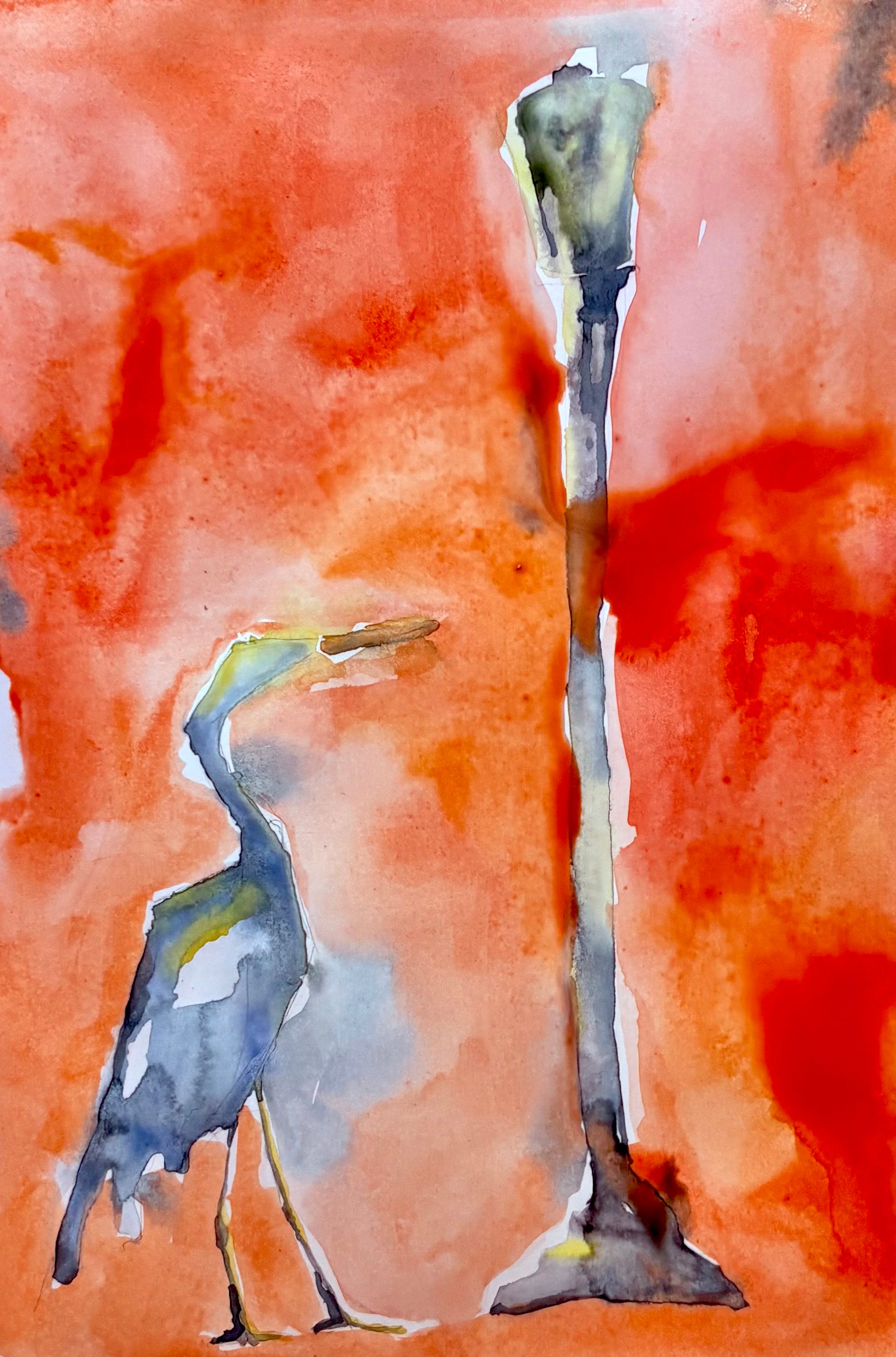
It was one of those delicious humid nights when the leaf-laden trees themselves seem to be melting the earth, and I was outlining the perimeter of the city’s downtown mall, past coffeeshops and bookstores and chic offices all empty and dark at this late hour, when a heron appeared out of the darkness, standing in the street, glowing slightly under the orange lamplight. This was nowhere near water, and not only was it late, but despite the hour there were still a couple dozen people on the mall, going to the high-end bars or simply hanging out. A heron should not have been there. I was struck by this thought: this heron before me did not belong here: it was an anomaly: it was a monster glitched out of the night. But there it was, staring at me. Its yellow eyes were intense and hateful. Its slender body trembled with rage.
Herons had taken on significance to me in the weeks before, when I discovered a pond on the outskirts of campus where herons hunted fish. They stood perfectly still for long periods of time, only moving after considerable thought, and even then with careful precision, as if they were rehearsing a ritual that must be executed perfectly. In the orange-red-purple light of the evening, I watched as they stood and practiced their exact gestures. They stood in the water, staring at the water, staring at their own reflections on the surface of the water. And I watched. It seemed like they would be able to extract something great from their reflection in the water, and I thought that I, too, would be able to extract something great. Here, the herons in their lonely patience had seemed like antique monks to me: they represented those values of solitude and mindfulness that you can find in the image of the ninth card in the tarot deck, the Hermit. I was so impressed by the herons that I wrote a haiku about them:
Heron in the pond —
What does he see? His beaks merge
And produce two fish.
I waited a long time to see just one heron catch a fish. The movement was slow and precise.
Now there was a heron just a few feet in front of me, having emerged out of the darkness, a long way from any water and in the middle of a busy part of town. I was surprised to see that the heron was almost my height. In the water they had always looked a bit smaller. This thought unnerved me: it was almost my size: it was almost my size and it was staring at me. After a moment it seemed that the heron was not inspecting me after all, which such a hard stare would imply, but was staring at something past me or something burnt on the lens of its eyes that I could not see, the ghostly image of a flame that had long since been quenched. Eventually it bobbed forward and turned toward a small patch of grass under one of the gingko trees that lined the mall.
A man beside me started speaking with great excitement, like a drunk jabbering at a basketball game. I hadn’t noticed the man until he spoke, much like I hadn’t noticed the heron in the street until it emerged from the darkness. Unable to understand his words, I turned to look at him as if sight would help me hear what he was saying. He was disheveled, and his clothes were stained with days and years of dirt, but his wide eyes shined with singular power, two live wires sparking in the darkness. The man said something with great emphasis, repeating the last word several times. I repeated the word back to him and he nodded in recognition, repeating the word again in affirmation. He spoke more, an onrush of words, making an eating motion with one hand and pointing to the heron with the other.
I looked at the heron. It was standing over a hole in the grass, bent in the same gesture of reflection that those herons at the pond made when hunting fish, except here the dust in the small patch of grass would reveal no reflection. And yet the heron stood still, waiting. The earth and water had been confused. The man chattered in his swelling of words with no meaning. Out of the hole, a rat stuck its head, scenting the air, and in a feral swoop of its beak, the heron snatched it out of the hole, holding the rat by its neck into the light like a precious relic removed from the earth by a tomb raider.
The rat was huge. It was the size of my forearm. And it strangled out a high-pitched scream that rang in the humid night air, calling for anything to save it: rat, man, god, anything, its scream trying to evoke anything at all to raise a rebel fist against the heron. The rat’s tiny claws struggled against the grip of the heron’s beak. But the heron just stood there, waiting. The rat screamed. The heron stood waiting.
I looked at the man beside me, who was talking again. His wide eyes overflowed with glee. He repeated a word several times and he smiled. It appeared he was telling me, with great mirth, that the heron was eating rats, as if the evidence of my eyes wasn’t enough and so the testimony of my fellow man, even if babbled into incomprehensibility, was the only way I could understand this thing. In a way, this was right: I couldn’t understand what was going on before me: I felt like the world had been reversed: and my stomach turned in revolt against this unsettling of the earth.
I turned to look at the heron again, which still was waiting as the rat screamed. Then it shook its head one way and then the other in two measured flicks, a gesture somehow recalling a bullfighter wiping clean his blade. The rat had stopped screaming and hung limp in the beak. As I watched in horror, wanting to look away but unable to, the heron raised its head to the moon and crammed the rat down its bulging gorge. While the bird was tall, it was also quite slender, so the large rat must have been half the size of the heron’s stomach. For a long moment, the long tail of the rat hung only half-limply from its beak, like the tongue of a hummingbird that probes flowers for nectar, but more sinister, perhaps because this “tongue” hung at an odd angle out of the side of the heron’s beak, so that it was more like the lolling and drooping tongue of a beast ravenous and crazed. Then the tail, too, slid down the heron’s throat.
Now the heron returned to its position of monk-like reflection over the hole. To my horror, it repeated this with three more rats. The whole time, the man jabbered with great emotion as the heron ate and ate and ate beyond proportion of what I imagined could fit in its stomach. It was gorging itself. I even thought it would explode if it kept eating. While I watched and the man jabbered, men and women dressed up in nice outfits walked up and down the mall, going to bars and restaurants at this hour, deep in the middle of a pandemic that had calamitously ruined the years of my youth, a pandemic that had sentenced me to wander the city alone and bereft of something I had never known. None of the men and women stopped to look at the heron. It seemed that none of them cared about it at all. It seemed that this sight — the heron, the rats, and the man speaking frantically in an unknown tongue — was a curse only for me to witness, that it was almost especially designed for me. I looked at them with eyes that tried to silently beseech them: look at this: witness this horror: acknowledge it. But their pace did not even so much as shift; their conversations remained casual and calm. I am unsure how long this lasted. It felt like an eternity, but it could not have been more than an hour. When the heron returned to the hole to eat yet another rat, which it surely could not eat without bursting, I was finally released from this image. I tore myself away from this scene and escaped down the closest street, into the darkness.
My youth was dictated by confusion, isolation, and fear, and to find ways to silence this confusion, I had taken to walking, to looking at the world for answers. Job’s fault, of course, was that he would even dare question the world. I thought that if social life was confusing, isolating, and fearful, then the natural world, the world that could be walked and seen, would provide glimpses at the opposite.
And yet my walking presented me an image of more confusion. Here was a bird that had once reflected gently on the water to unveil a hidden truth: the fish and the image of the fish doubled in the water. But now that image had itself been confused. Instead of water, with its quality of self-reflection that seemed to inspire the heron to attain a hidden truth, there was the dust of the earth, there was the night, and instead of the fish that disappeared easily down the heron’s beak, there was the rat that struggled and screamed. I sought enlightenment, and I thought I’d found it in the image of the herons by the pond at sunset, but in my insomniac wanderings the world had revealed the shadow-image: the heron in the dirt at night.
And then there was the man babbling mutely, incomprehensibly — the concerning double of my own self who had once sought to communicate the former image through writing. Faulkner, ventriloquizing Shakespeare’s Macbeth, was terrified that his writing would be sound and fury, signifying nothing. And here I was confronted by my own sound and fury: words that glided and bubbled so beautifully and yet with no meaning at all. Were my experiences, which felt so lonely to me, just incomprehensible babbling? What could I do to make it make sense?
The heron eating the rats in the park operated by dream logic. I had the conscious assumption: the beauty and reward of loneliness and self-reflection. Then I was presented with a subconscious reaction: the delusion and incomprehensibility of the very same things. Like any powerful dream, this image that appeared before me out of the dark, out of my nighttime wandering, affected me deeply. I didn’t know what to make of it. I wandered the city, I wandered the campus, I wandered through the nights, considering this image.
Coming to college in the height of the pandemic was bizarre because everything I had expected of this critical period of my coming of age had been flipped: where the movies showed parties and sunshine and a bunch of new friendships, I was presented with isolation and empty dorm hallways and a routine dominated by the darkness of insomnia. To a certain degree, I had applied this brutal logic to myself. The world had been consumed by such extremes of purity and safety that I sought, without being aware of it, an extreme life of purity and safety, a life that was the confused version of monastic order. I lived a pure, simple, lonely life, dictated by the routine of waking at noon, eating very little, talking to hardly anyone, and walking long through the night, sometimes not returning to my dorm until dawn, which, empty as it was of a roommate because of the pandemic, resembled very much a monastic cell. Loneliness was what I needed, or so my thoughts went — loneliness is health, loneliness is good for the community. At only eighteen, it was easy to take things to the extreme. My loneliness was not my confusion, or so my thinking went — my loneliness was my beauty and my pride, and this was the problem: I was in a headlong spiral into despair.
Originally, seeing the herons in the pond confirmed the selfish attitude I had towards loneliness. They were, after all, alone on the water when they produced the fish out of their own reflection, an autogenerated enlightenment. I applied this to myself and considered my current lonely existence as a kind of secular monastic experience. Surely, I thought while wandering the streets of the city, my pain would lead to an enlightenment. Surely my solitude and reflection would generate something. If the world around me was confusing and painful, my lonely questioning of the world would create an answer I needed. Why was my experience of life so different from what I had expected? Why was I so lonely? What did I do to deserve this? These self-centered questions rang through my head as I tried to figure out what was going wrong with the world. I asked these questions over and over, hoping somehow to create something so beautiful and worthy out of this loneliness and confusion that all of the prior pain, that which I was feeling now and even deepening by my own actions, would be sublimated — almost as if I could make myself happy by using a dialectic that went from loneliness to beauty to happiness — thesis, antithesis, synthesis. The questions continued, but the beauty did not come: I was like a pilgrim beseeching the broken idol of a bygone god, praying on something that would never answer because it could not answer.
The image of the heron in the park at night communicated something important to me with an undeniable logic that cannot necessarily be communicated, much like the image of a dream. Its meanings are difficult to fully extract in words, but somehow I was struck that night by a feeling of seeing my own self reflected in the heron, in the rat, in the babbling man, and through that image which operated much like a prism — which catches the light and expands it — further meanings developed surrounding the herons in the pond, which seemed so beautiful and noble to me, forcing me to consider what the herons in the pond were doing right that the heron in the park was doing wrong, and what this meant about me, or rather what I was doing wrong in my life that I projected onto the image of the heron in the park, and what I must do better based on what I had seen in the herons in the pond. My task was now to investigate these feelings, these dream logics. The result of this investigation of my own self, which is so hard to put into words, made me realize that my prior investigation of loneliness was just remorseless babbling, much like the man in the park, and that to focus so much on my own loneliness was to create more of it.
It guided me towards a solution. I had been, perhaps, overly concerned with the confusion and isolation of the pandemic. You could say that this period, which was nonetheless a serious one, had become an excuse for me to escape from the necessary risks and challenges of becoming an adult by seeking further and further loneliness. I, a lover of Rimbaud and Dostoevsky, had reacted poorly to this situation, about as bad as one would expect from a teenaged enjoyer of Rimbaud and Dostoevsky. Like the heron in the park at night, I was reflecting on dust to generate only misery: I was both the heron lost in the darkness, confused into nourishing itself on loneliness, and I was the rat in the beak suffering from this confusion and loneliness. I was, from another angle, the man who watched this cycle of suffering with remorseless glee, speaking with great meaningless eloquence on a spectacle that meant nothing at all (my notebooks of the period do verify this analysis, although I won’t subject anyone to reading them). I was, like the three beings in the image, misled. Being by nature attracted to art, I sought to find something beautiful in the isolation I was experiencing, to even make this suffocating feeling noble, to exonerate loneliness by finding something meaningful in it, and, through this, to make the disappointment and sadness of this period, caused by the pandemic, beautiful, artistic. I wanted so desperately for my loneliness to generate something. But while my loneliness was generative, it was generative only of confusion.
To me, the heron in the park was feral and nightmarish. It reflected on darkness to create horror. It was tricked by some illusion to generate pain and incomprehensibility: the rat’s screams and the man’s babbling. Meanwhile, the herons on the pond were self-reflective, noble, and enlightened. They saw through an illusion, the surface of the water, to generate both a fish and an image of the fish. In a very simplistic way, this image was much more natural and wholesome. I thought about this difference and how it could apply to me. I had become lost in my own experience of loneliness, walking endlessly in it as a way to probe the depths of something that had no bottom. If I were to truly grow, I needed to see through the illusion. What would that mean?
I thought about the herons in the pond. They reflected in solitude, this was true, but there were several of them on the water, and once they had caught their fish, they all took flight in unison and flew together to some common destination. In my analysis of the herons, the herons in the pond had a deeper symbolic connection to each other which the heron in the park lacked. In other words, there was a time for their isolation, but in order to truly benefit from their reflection, that isolation must end. They had their moment of reflection, of isolation, of silence, but it had a natural end that drew them all together, to go on with their lives.
Being confronted by the heron in the park, an image of such horror to me that I had a genuinely visceral reaction to it, helped me realize that my loneliness at the time was, to a certain degree, a self-inflicted problem only thinly veiled by the excuse of the pandemic; I was obviously disappointed by the reversal of what I expected college to be, but I deepened the disappointment into an unanswerable investigation of what loneliness means, of what was wrong with the world to cause such problems, turning what should have been a minor setback into a greater obsession, into an unhealthy isolation. I needed to end my isolation and be a kid, experiencing life away from home for the first time. Of course, the pandemic had caused great changes in what my coming of age would look like, but I had made things worse by refusing whatever opportunity still existed in these conditions. After all, things weren’t so bad. I was surrounded by people much like me; I just needed to take the risk of meeting them. Like the good herons, the herons in the pond, I dipped into the waters to reveal something hidden and I emerged with two rewards: the fish and the image of the fish: the physical and psychological gains of self-reflection.

THE YOUNG AMERICANS
 | A guest post by
|
The heron in the park is a great image of survival of the fittest- adapting to the environment in order to survive. Glad it was the impetus to get out and end your loneliness.
Hi my name is Nadav and I enjoy this essay.