
Imagematic Life
“I am finding it all too easy to abandon my imagematic way of life.”

THE NEW CRITIC
Grace Caplan is 21-year-old senior at Dartmouth College studying English.
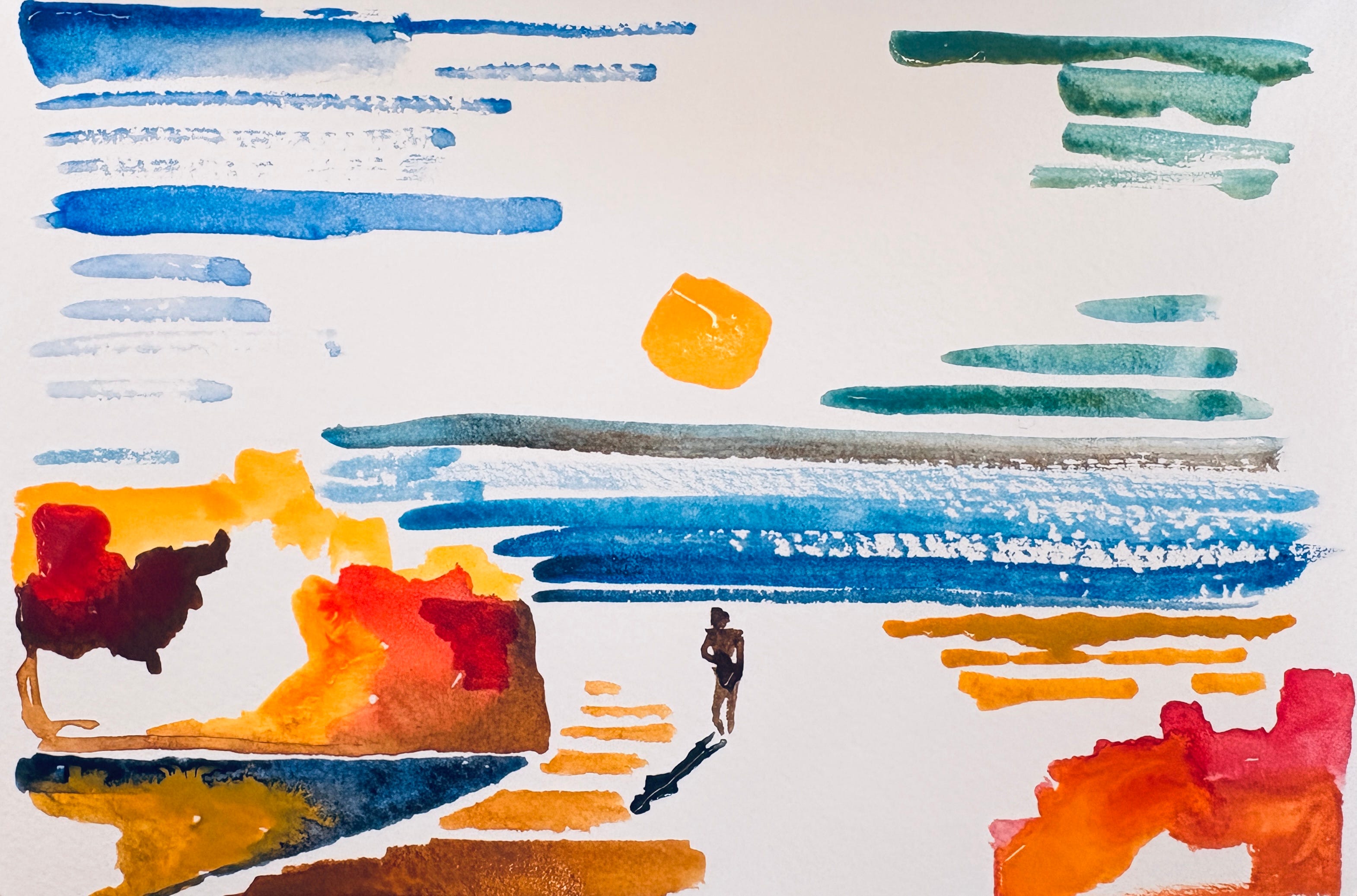
One night last winter, through melodramatic tears, I told my boyfriend to listen. I had been trying to communicate something which I found extremely difficult and which I now know is impossible. After months of dating, I wanted to tell him who I was, that is the urge of love, after all: to divulge the self in its ragged, tearful state and have it accepted. I said, imagine a clay wall like you’d see in the old medieval remnants of Southern Europe or North Africa, those reddish, smooth, earth-packed walls. Behind, there is a flat sky, the color of blue that appears when the sun is at its highest, whitest point. The ground in front of the ruddy wall is also reddish and sandy, silty; it could billow into the air if disturbed. As it happens, there is a slight movement at the periphery. A figure that was still has moved her hand. She is wearing armor. The details of her are obscured but I am sure it is me. I really am sure of it, I told him, if you are curious.
He was, and so he listened with generous attention. I was shocked that this strange admission made any sense to him. I had just told him that some essential quality of me could be understood by this shakily articulated image. I was even more shocked that as I made this impromptu declaration, I felt relieved; it was ridiculous, I knew, but it felt true in a way that so many stacks of words I had supplied throughout my life in an attempt to explain myself did not. (In the most dire cases, I would say “umm…I like to read and hang out with friends I guess. I’m an ENFP, sometimes an INFP. If I were an animal, I hope I would be an otter.”) Why was it? What was it about this scene? What was I saying when I described this image? Reflecting now on that moment when I struggled finally to speak about myself, I realize the centrality of the image in my life.
I grew up in rural New Hampshire, surrounded by nature. At home, things moved quietly and very slowly. When the weather was acceptably warm, I would go to the field outside my house where my dad had planted rows of grape vines and watch a beetle crawl over a blade of grass. The sun would shine particularly through the silvery grape leaves exposing their veins and their small fluttering movements. I would ride my bicycle to a reservoir and stop along the flowing river. Minutes would pass in extended reverie, noting the glints and dips, I tried to follow a piece of water as it sank and moved on. These passages of youth, spent noticing and feeling beauty, shaped the structure of my interiority.
At some point, I began to write. It felt remarkable to be able to articulate what was in my head. Language and feeling became inextricably connected in these early years of experimentation; I wrote what I felt and learned to feel through what I wrote. Aside from my early accounts of desperate adolescence, I was largely drawn to descriptions of images. I practiced with language. For example, if I were sitting on my porch, looking at the peonies that waved in front of me — whose feathery petals I could feel if I stuck my feet below the railing — I would write sentences to describe them:
the bowed head of a peony, like a heavy crown
with a heavy crown, the peony swayed
her thin petals are like ribbons, or waves
I used metaphor in this process to create associations between the images; the words were useful bridges, but they quickly became an end in themselves, an exploration of what language could evoke.
the bowed head of the peony like a willow branch arching over a pool of water
like an old man stooped at the foot of a tree
I was creating a catalogue of images that formed networks of associations. Like many children, I experienced the world largely through images, and the structures of the networks I created were how I related primarily to my environment. Onto these images I implanted my imagination and my stories. Then I used what I knew to understand what life was and what it meant. What I came up with was that the images that I saw and my ability to imagine had something to do with the answer. The beauty and, consequently, the importance of my life were reified by my descriptions of the beautiful images I saw. A successful life experience (pardon the characteristic certitude of my early revelations) rested in my ability to articulate beauty. If I could understand myself as living amidst beauty, I could imagine myself as dignified and important. Then I could go further with my fancy and imagine myself as a poet, a queen, or a knight.
Last winter, when I visited the Spanish city of Cordoba, it appeared to be the pinnacle of beauty — the medieval ruins and the white doves, the green rolling fields and the Roman bridges, the orange trees and the Moorish cathedral — what was it about this beauty? Something particular about the preeminence of its history charmed me. The three-piered arching bridge over the shallow river where pigeons waded brought me back to the bustling Roman hub that the city had once been. Cobbled streets parted their paths around the bases of the old orange trees; they led to the central mosque built by the laborers of the Umayyad Caliphate. In the old Jewish quarter, one particularly narrow alley opened up to a statue of the city’s famed Maimonides where I touched his beard for good luck in amorous affairs, as is custom. Looking beyond the city, over the bridge to the sunlit hills in which nestle distant turrets and spires, the history dropped away and the landscape endured. As I walked through the city, I shifted through time from the old through the modern to the ultramodern — the ruins — the overstuffed bookstores and cafes — the flashing Zara and Adidas displays in sleek storied buildings. The images of the city made me feel timeless, from a court poet to a Hemingway-esque aventurera, I imagined myself as an abiding spectator of beauty.
When I sat on top of the wall of the old alcázar, the stones growing colder in the evening, I took out my journal. My feet kicked the clumps of grass that had settled in the sunken nooks of the rock. My face was still touched by the golden light, and my mind wandered to the images that I saw of the city. When I picked up my pen to describe my sensations, I imagined that I was a hundred different versions of myself, sprawled throughout time. This imaginary lineage allowed me to feel an existence that prefigured my birth. In the perception and articulation of the beauty of the city, I felt as though I was stretched out past the boundaries of my life. This imaginary transcendence felt at once totally distant, fleeting, and also at my core of being.
The images that attract me are ones that act as a sort of tunnel through which I can imagine myself or make myself into an image. Perhaps, a tygress. As William Blake imagined in “The Tyger,”
Tyger Tyger, burning bright,
In the forests of the night;
What immortal hand or eye
Could frame thy fearful symmetry?
The tyger is powerful and unbounded, and its home, the dark woods Blake invokes, is a place outside of time: where the sun cannot mark its passing and is instead dark, obscured, and infinite. If I am the tygress, my forest is made of the images I am allowed to slink around in. Their origins are paradoxically proximate and distant, a place unaccounted for by time.
When I was young and would sit beside the vines or bicycle down the dusty roads of my small town, I distinctly remember a sick sort of feeling in my chest. I was totally rapt with the beauty of the natural scenes but I felt, at the same time, a vague despair when I realized I could not appreciate it to the degree it seemed to demand from me. It wasn’t enough to look at it, I wanted to take the beauty in, to incorporate it in some way. My attempt at this was to capture it in writing. If I could work to find a way to describe the images I loved, I could get closer to having the beauty. However, it soon became clear that writing is an attempt done with the too keen awareness of its own failure or the insufficiency of language and the impossibility of capture. Writing is composed of both articulation and its reverse — like a mirrored reflection, it inevitably gestures toward its own remainder or that which is ineffable. This came to me as both an immense frustration and an appreciation for a beauty that could be so vast as to resist articulation. Writing was occupied by two joys, the joy of the attempt and the joy of the failure — its process was the very fact of negotiating that which cannot be said.
Like writing, beauty seems to implicate both its existence and its negation. When looking at a beautiful scene, one is struck by the richness and the importance of life. At once it feels as if you are part of a transcendent scene and that you are aware of the nullity of life; that is death. My professor once explained to me Walter Benjamin’s aesthetic theory (as written in The Origin of German Tragic Drama). He explained that people want to write about sex and death — things that essentially fascinate us. But because these topics, if written explicitly, will tip into a type of pornographic titillation, writers sublimate their desires into what then becomes art. What constitutes an “art object,” as my professor described, is accommodated in culturally approved aestheticism and only contains a seed of terror or abjection.
The “art object” must be perfectly balanced — nearly unsteady in its upright stance, threatening to go to pieces but ultimately holding back, sufficiently sublimated. Recently, as I was reading Thomas Mann’s The Magic Mountain, the character Naphta expressed, perhaps with tongue in cheek, a similar idea: “Works of art from a world in which the soul expresses itself… are always beautiful to the point of ugliness and ugly to the point of beauty.” This paradox in human-made art is fundamental to the way we judge all images. Naphta’s perspective comes from a belief in a distinct dichotomy of body and soul: “We are dealing with beauty of the spirit, not of the flesh, which is basically stupid.” Therefore, any observer of an image is a witness to the tension between spiritual and material beauty, which are always directly at odds. One part of a consciousness (the more elevated spiritual aspect) is always whispering counter to our initial impression of beauty or ugliness. However, there is something to be said for this paradox even if you do not subscribe to the same philosophy as Naphta. To be sure, all of us seem to be uncomfortable in our materiality. (We stare at the face in the mirror, shift our posture, wish we danced better or were taller or shorter.) At the same time, we strive toward something that seems to implicate belief in a spirit. Casting aside generalizations, I can say I remain searching for a type of spiritual transcendence that in some way is disengaged from the material world. What this exactly means is shaky. To face the necessary precondition of transcendence which seems to be death is terrifying.
Similar to Naphta, my perspective experiences a continual tension between desire and fear, beauty and the whispers of ugliness. When I look at a beautiful image of the setting sun, I at once experience the overwhelming beauty that both threatens and promises to lift me up and away and the jolt of fear at the remembrance of death and the condition of finitude which prompts my mind to indulge in ideas of transcendence.
Perhaps what has become abundantly clear in the process of writing this essay is that I am continually looking for ways to transcend, which probably signals that I am deeply uneasy with the precepts of this life and that I am frequently looking for ways out through the images I seek and the imaginations that prevail. Many years ago, I tried to reconcile this feeling of both awe and fear that arose within me from an image. I was biking on a flat road in the heat of high summer. I unexpectedly dismounted my bike as I passed an outlet to a slow running river, which was an old boat launch, perhaps used in summers past when the river ran deeper. For a few minutes, I watched the water sink and shell forth. As I walked away to resume my ride, a thought came as if in answer. I realized that death, which to my young mind was an unthinkable terror, was a sort of final and total collapse into beauty. I often stood looking to the distance, to the hills, in the warmth of the air, the smells, and the slanted evening light. I was always frustrated by the distance between what I could see and what I was. I really wanted to belong to this overwhelming natural beauty. Death, then, would be a complete diminution of this frustration, in totality or absence. Either way, it would be settled, and this omnipresent tension would relax. In a small way, I had found some version of that ultimate reprieve in this anticipatory stance. It was, of course, naïve of me to think that anything regarding all this could really settle. I had found momentary peace in understanding death to contain beauty, but the problem has reappeared hundreds of times since then. I know now that there are many ways to struggle with these tangled human questions. I have created new concentric circles and erased them.
One such attempt was made last year in Madrid. I wanted to spend a few months living alone, using my spare hours to sit and write on the various ledges of the city. I thought I could find something in its silent images, alone with my own language. It was a romantic idea, and while I was enamored by the beauty of the city, I was also desperately lonely. I liked to walk down to the palacio at midnight to sit on the steps and watch the street lamps hit the great angles of the structure. Watching people’s late night movements, I imagined invisible currents directing the endless movement and reformation. I liked to stroll around the gardens of the palace during the day with my notebook, to sit under the large looming elm trees or maybe, after mazing myself through the small paths around the rose garden, I could spot the roaming flock of palace peacocks. I liked Madrid’s balconies and her winding stone alleys, all the shadows and all the lights.
I remember once walking down a deserted street in a new neighborhood on one of my first nights there. Ahead, I was confronted by an offensibly bright light. I soon understood its source to be an unshaded heat lamp, like those used for chicken incubation or other utilitarian occasions. Hidden behind the light that would temporarily blind all observers was an old man hunched in a hard-backed chair. He was determinedly flipping the pages of a small book. Beside him, I glimpsed — at this point, I didn’t want to stare, or modulate my pace any further — a stack of books. He was clearly moving through them as if on a strange, time-sensitive mission, alone in this narrow alleyway. This image stuck with me. I wish I had spoken to him in whatever bastardized Spanish I could have mustered. I wonder what he had already discovered and what he hoped to yet?
I contemplated the beautiful images around me a lot in my endless autumn in Madrid. The same solitude that opened up the time and space to indulge in these long hours of thinking also brought thoughts of death and anxieties about mortality. And my memory is equally conflicted: I occasionally remember the beauty of the time, but I have largely tried to shutter my experience away and the heavy loneliness and morbidity that came with it.
Now that I am back in university, I don’t think so morbidly anymore. In a large part, I am less concerned with beauty, too, or any of this theorizing. I find myself busier, and in many ways, my routines of healthy occupation and socialization make me happy. However, they come with a tradeoff; I am far less watchful, and the images that so shaped my life at times now pass me wordlessly. I have fewer encounters with the sublime, fewer attempts to articulate these images, and subsequently fewer contemplations about my own language and life.
I am finding it all too easy to abandon my imagematic way of life. I am terrified of graduating from university because I don’t know what or where I will be. I am scared of losing my images and my imagination as life churns onward from childhood. Are images the first thing to go as life speeds up? They seem to unveil themselves in moments of slowness. Children watch the clouds crawl across the sky and shift with the winds. Close to the ground, they can gaze into the pistil of a flower and imagine life spawning from its center, a world enclosed in a flower. Adults move to New York City, where they work to afford nicer apartments and ritzier jackets. They go to art galleries on the weekend and make friends and have good conversations. They lie in bed late with their partners and laugh and watch films and sit in the park and call their parents and go grocery shopping and read and go to work and meet friends of friends at the bar and have a grand time and come home again. Where do I go? Where, in all this, is the me which I tried to tell to my boyfriend, the me in the deep sky and the glint of armor? Will I forget about beauty until I am much older and things are slow again? Will it come to me years down the line, and I’ll suddenly remember that feeling long ago of standing on a warm summer day in front of a freshly rained field, the air still hanging heavy, illuminated by a spear of sunlight striking through the grey sky, each leaf of grass holding some of the light in a drop at the tip of their bodies, the birds having begun to dive into the longest grass for their evening meals and emerging again, flapping triumphantly? The sun will sink soon and submerge us all in darkness, I know. Right now, I can only stay still, transfixed by this zoetrope. All I want, my heart leaps, is to strike right to the heart of beauty.

THE YOUNG AMERICANS
 | A guest post by
|
Wow! really great piece, strikes at the heart of writing and its weaknesses, and the image and its weaknesses too——would love to read more by this writer
Since you have an acute visual memory, you will continually remember those moments of great beauty.