
Experience Is Psychosis
“As part of the school’s Covid policy, we both had to spend ten days in isolation.”


THE NEW CRITIC
Will Diana is a 24-year-old writer and poet living in Washington D.C. He studied sociolinguistic anthropology at the University of Virginia. He writes The Hermit Speaks.
Many experiences in my life, especially when I was younger, have come with the lunatic brutality of revelation, ambushing me in the hills like wild-haired, sad-eyed, armless bandits leaping leglessly to grab me and drag me off into the wilderness. I wonder how much these experiences, legless and armless, fail to really mean anything before disappearing once more into the wilderness, into the night, into the world. Covid, which struck when I was 18, was one of those experiences, and it only confirmed this suspicion I have that the world itself is entirely manic and impotent. In particular, I find myself constantly questioning a ten-day period in the winter when I was isolated in an apartment with a bunch of guys who I didn’t know and who had, like me, gone feral. It was, like everything else in my life, entirely idiotic and pointless. This was a pivotal moment, so it only makes sense that I return to this time in my quest to understand what experience really means, how memory transforms it, and whether we can learn anything at all about the world. What did it all mean? Why did it happen?
In February 2021, the height of the pandemic, I was a freshman in college. I was standing on a hill beside a dorm complex I had only peered at nervously for the past handful of months. It had snowed two days before, and the whole hillside was blank. The same night that it snowed, my friend and I were walking around drunk, and being two drunk, pent-up, confused, bored kids, we went on a stupid drunk rampage. We picked up a rental scooter and threw it over a bridge into a ravine, yelling “FUCK VEO SCOOTERS!” We pelted icy snowballs at the dorm’s darkened, mysterious windows, yelling “FUCK COVID!” Exhausted and laughing hysterically, we rolled down the hill in the snow, yelling “FUCK THIS SHIT!” Lying in the middle of the road, we chugged our pocket beers, crushed the cans, and threw them at the physics building, where they made a flat thud against the immense brick wall.
Just a day later, my friend tested positive for Covid. As part of the school’s Covid policy, we both had to spend ten days in isolation. My friend was sent to spend that time entirely alone at a hotel downtown. By chance, I was assigned to the isolation dorms at which we had just pelted snowballs.
As I walked up the steps to the dorm, I noticed someone had spraypainted the name OTTO on a large metal tube lying nearby in the snow, as if some construction project had been started and left unfinished by builders who had then mysteriously disappeared, leaving behind only wreckage. I stopped to look at this name, OTTO, on the metal tube that didn’t really belong on the otherwise orderly lawn. This name on that tube was very pleasing for some reason, and after thinking about it, I realized it was because they had the same topography, the name and the tube: two open circles at the ends of a chain — OTTO, a tube, a telescope, a microscope.
I carried with me all the stuff a stupid 18-year-old boy thinks he will need for ten days in isolation: eleven books, five pairs of underwear, a handle of vodka, other odds and ends. I looked up at the building that I was to be trapped in. It looked small, dirty, a little evil. Its windows were huge and dark, the eyes of a sleeping beast. According to the email I had just received, I was to report to my room in the building and stay inside for ten days. If I left my room, I would be suspended.
I wasn’t exactly sure what I would find inside the isolation dorm. Since arriving at the school in the fall of 2020, this particular dorm had loomed ominously in the near-distance. No one really knew what was inside. My other friends had been sent to hotels for isolation. They said it had been a pretty bad ten days, being totally isolated in a small room. As a college freshman, that seemed like a long time to be entirely alone. I opened the door expecting solitude. But I found eight guys in the living room standing in a loose circle around a massive pile of alcohol.
It turns out these isolation dorms were made up of suites. Instead of a cell, I was confined to a large apartment. And because I had caught Covid during the huge spike in cases that ensued after frat rush, almost everyone in the isolation dorm was a frat kid looking to continue the party. This set of circumstances meant that instead of crushing loneliness, I would be subjected to something truly odd.
My particular dorm was full of a bunch of strange characters. Three of them had caught Covid two or three times by February 2021, which was still a few months before the first vaccines became available. They were badly sick: fevers, confusion, a total lack of taste or smell. And they spent the whole time partying like everyone else. After arriving at the isolation dorm, we all stood in a circle, comparing the alcohol we’d brought along for the stay, which still seemed impressive and cool to a bunch of 18-year-olds. I showed off my handle of vodka. Very nice, a reliable choice. Understated, but effective. Essential, even. The plastic bottle really ties the whole thing together. An ROTC guy showed off his mason jars of authentic moonshine. Very cool, not often you get to drink moonshine. Another guy brought Jack Daniel’s, which was the real winner. Jack Daniel’s, now that is class my friend. Can’t wait to have a night with my old friend JD. You don’t mess with Jack, amirite? Others also brought cheap tequila, Pink Whitney, rum, an ounce of weed, and some coke and Adderall — whatever could be easily packed, whatever an 18-year-old boy would think was so Awesome that he had to bring it with him for isolation. Because it was the pandemic, we all mostly lived through memes and versions of ourselves we could transmit online. Like me, these guys probably thought they would make a funny Snapchat story of themselves getting drunk or high in a hotel room, alone. Now we all laughed, talking about how this isolation wouldn’t be so bad after all. Proud of our kaleidoscope of substances, we all felt very mighty and cool until one of the guys, who was shirtless, sighed and said with great disappointment: Boys, where the fuck is the beer?
This was a huge loss for the cause. No beer? How could we cross the desert without our manna? What to do...
At that moment, one of the guys mentioned he was an RA. The air left the room. Some of our friends had already been suspended from the university for six months at the hands of some RAs, zealots of Covid policing, for the crime of bringing a girl into the dorm or talking with more than three people. Realizing he had instantly lost our trust, he said, I’m 21, boys. I’ll go get the beers. Don’t you worry. And at that moment, he walked to the closest corner store and came back with two thirty racks. I think I was the only one who had misgivings about a guy with Covid walking into a store. Regardless, he had won our trust. Grinning, we cracked open the first beers.
This was a hard time, a strange time. Not many young people were happy during Covid. I felt as if a key part of my adolescence had been robbed for reasons entirely beyond my control. One’s senior year of high school and their freshman year of college are the two periods of life that dominate American coming-of-age films. I’d spent my whole life raised on these images. Since I was a teenager, I’d anxiously awaited the moment I’d no longer be some dumb child and finally be a cool college kid. These years were the time for a key initiation rite that had just suddenly disappeared. Instead of Lady Bird, Animal House, or 10 Things I Hate About You, I was thrown into a period of isolation and loneliness. I was intensely depressed, angry, confused.
To further complicate things, the very strict Covid regulations, overbearing as they were, also seemed morally good to me. I wanted to be a Good Person and Protect the Community. The times I went to a small dorm party or the bars in the months before this episode of isolation, I felt as if I’d personally contributed to the deaths of millions. In these instances, I often acted much more ridiculous than I would otherwise, as if I should just commit to being terrible. Many other people acted like this, too, and any social scene that did exist in small gatherings at dorms, apartments, bars, or frat houses was an abomination dancing the witches’ sabbath at the outskirts of an empty kingdom. It was an oasis of horror in a desert of boredom.
The people were insane, cruel, ridiculous. The bathrooms were covered in piss and trash. The halls were covered in piss and trash. In odd frenzies, kids ran rampant through the dorms and the streets. Stuff was constantly stolen, broken, torn to shreds. Life was pious loneliness or social pandemonium. Neither extreme made sense, neither gave me any satisfaction.
Most of all, I didn’t really know what was going on, or why. I reread The Trial, The Castle, and Crime and Punishment. I would lie on the floor, listening to songs on repeat, trying to understand why this was happening. I was obsessed with the Book of Job. I liked Job’s doomed quest for understanding, his constant questions, his friends who didn’t care about his suffering and mocked him, the young Elihu who called Job and his friends a bunch of idiots who didn’t truly understand the world of dreams, the God who came down from a whirlwind and told Job that he can’t know God. Job’s children were slaughtered, his wealth was destroyed, his body plagued; pious Job was severely punished for reasons he couldn’t understand, and for reasons that seemed ridiculous and petty to me. In the original version of the Book of Job, after all Job’s senseless suffering, after all his agonizing investigation of good and evil, God just kills him in the end.
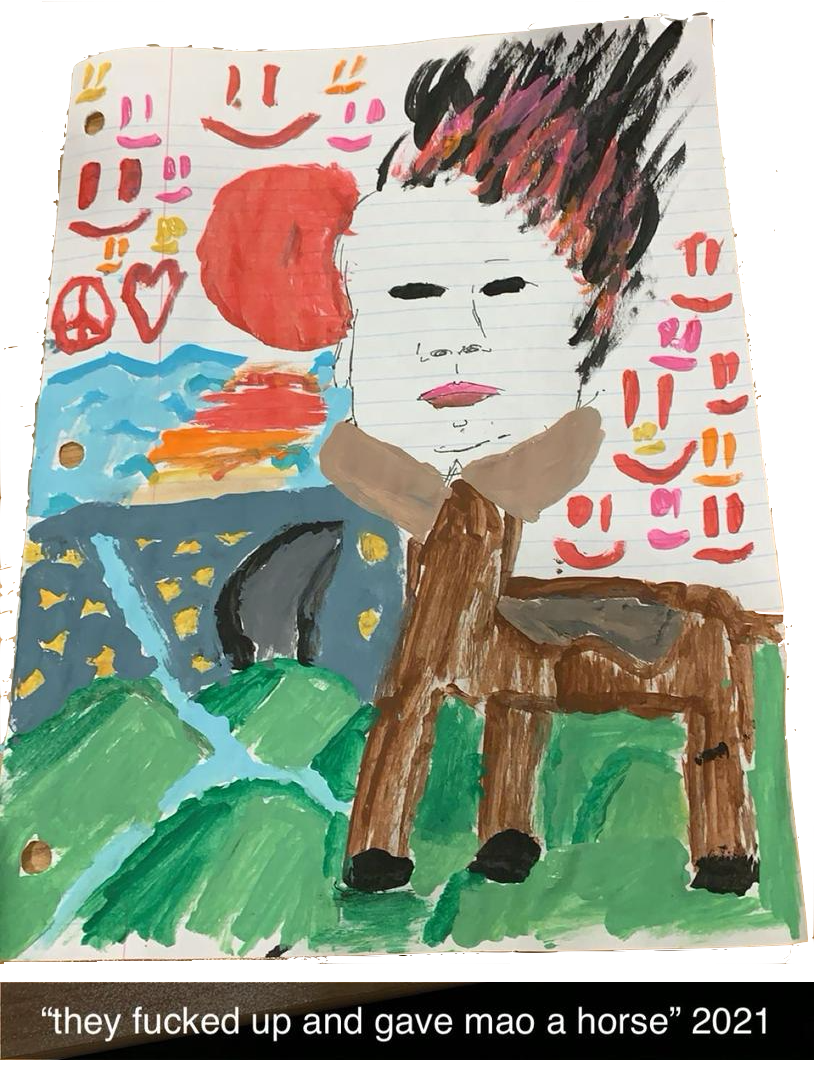
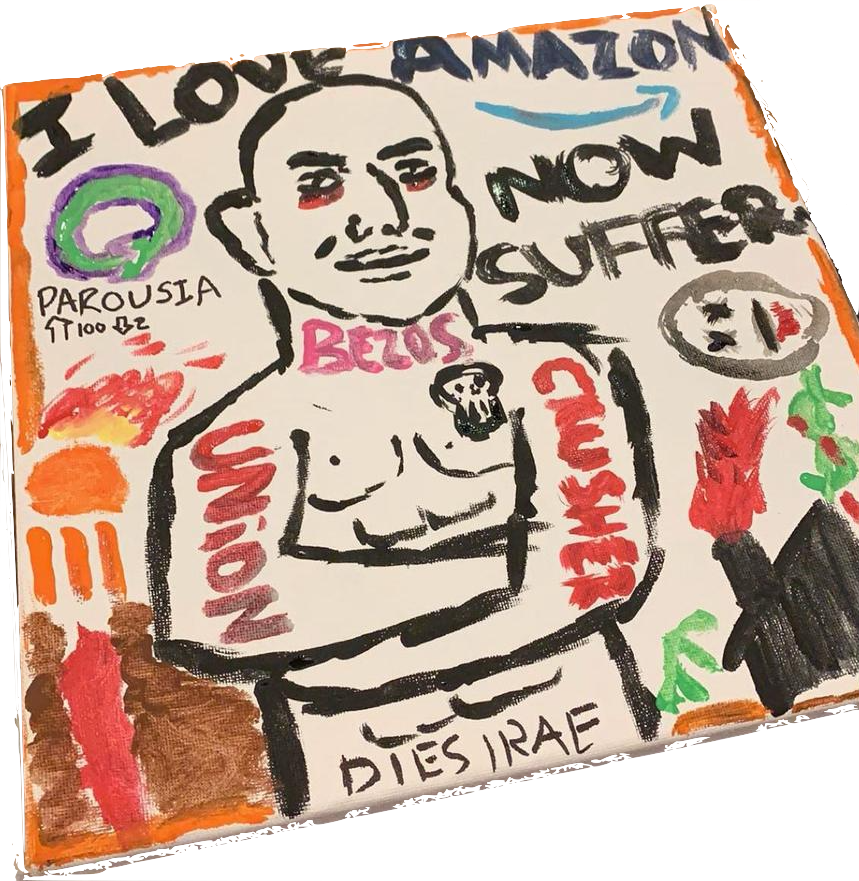
I lived my life through social media. My memories were just memes. I painted awful paintings and put them on my dorm walls, paintings like They Fucked up and Gave Mao Zedong a Horse (Diana, 2021), Jeff Bezos Floods the World With Pure Love and Understanding (Diana, 2020), or PAX AMERICANA (Diana, 2020). I was not a painter. The paintings were just brainrot that I spit out on a canvas, as if my brain had actually started to melt and was oozing through my mouth, my eyes, my ears. I would get ridiculously drunk watching Neon Genesis Evangelion or Breathless with one or two friends and then stumble to the dining hall, where the screens all proudly said WELCOME CLASS OF 2023. We were, of course, the class of 2024.
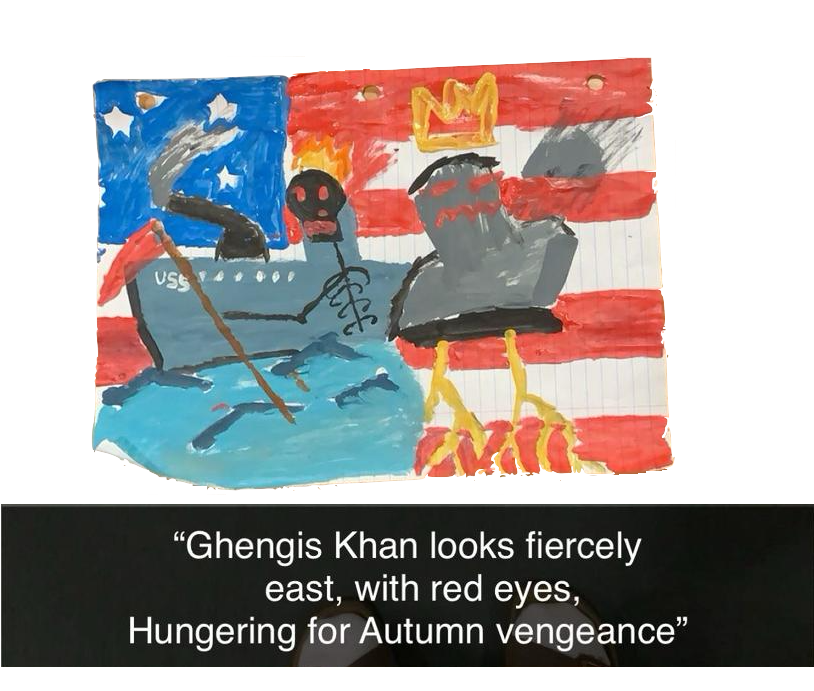
In the isolation dorm, it really was an oasis of horror in a desert of boredom. I never saw the RA again. Immediately after depositing the beer on the table, he locked himself in his room and never once left it. He didn’t bathe. I’m unsure what he ate, or if he ate at all. Every night, he stayed up till 4 a.m. screaming in a language none of us understood. Some assumed he was playing video games, but none had seen him carry a console and monitor into the dorm. Because he was in the room next to me, I was kept up by his constant, inscrutable shouting.
The other guys were spoiled burnouts, young finance bros and frat guys. Their eyes lacked the spark of intelligence. They didn’t understand why I spent half the time reading novels and textbooks when it was so easy to cheat on tests during online school, anyway. One of the principal characters in the isolation dorm was a guy named Hunter. The first day of Covid isolation, I was in my room when I heard someone scream FUCK YEAH! from the living room. When I came out, Hunter was shirtless, doing pushups. I asked him what he was doing. He told me that whenever he got a math problem right, he would shotgun a beer and do ten pushups. He had ten math problems to do that day. Hunter informed me very seriously that he only shotgunned beers. I thought this was a schoolboy exaggeration, but throughout those ten days, I never once saw him sip a beer. Like a jungle beast, he gulped down a Natty Ice in under five seconds and tossed its mangled carcass aside as he belched. This school was apparently a pretty good school, despite the efforts of its students.
But Hunter wasn’t all beers and brawns. He often sat on the balcony with a guitar, singing old pop songs to serenade the girls passing in the street below, calling them to have a beer with him on the balcony. It seemed he really thought he could convince someone to come hookup with him in the Covid dorm with just a song. Maybe he also thought they would be impressed by the sight of him shirtless, shotgunning a beer. Or else, and this may be most likely, he was a romantic soul: he knew this whole thing was doomed, but he tried anyway, knowing it would never work.
At one point, Hunter knocked on my door. Because he knew I was a writer, he asked me to help him write a love song for a girl. He was very serious about writing this love song for the girl. Even talking about the girl made him blush. I stayed up with him for a few hours, drinking and writing something in iambic pentameter (I didn’t know how to write a song). It was a genuinely lovely experience learning to write a song while he strummed the melody, picking up on and expanding on whatever ideas he wanted to use. He then recorded himself, shirtless (Hunter was always shirtless), singing and playing the song. He sent the video to the girl on Snapchat. That very night, he left the dorm to hookup with her. (Note: I think this proves that I am quite effective at writing love poetry. To any reader who needs help with their romantic life, Will Diana will happily write a love poem for the low, low price of one paid subscription).
I found out when he returned late that night that the girl wasn’t even in Covid isolation. He had gone to a dorm and hooked up with the girl while her roommate was sleeping. Neither girl in the room had Covid, which meant he had almost certainly spread it to both of them. He also told us the girl he was hooking up with had whooping cough, and she kept hacking her lungs into the pillow while he was hitting it from the back (his words, not mine) so that it sounded like he was fucking a mucusy, backfiring car. At no point did he seem to consider that he was spreading Covid to her and her roommate and would also bring back a new respiratory illness to seven other guys with Covid, three of whom were badly sick. Then again, no one else seemed to care but me: an oasis of horror in a desert of boredom.
A day or two after this episode with Hunter, there were parties everywhere in the isolation dorms. Everyone was genuinely elated they could party without having to worry about Covid since, after all, we all had it. When I returned to my room, I stayed up till sunrise for no reason at all. I listened to the RA scream in his unknown language. I scrolled on my phone, unable to focus, unable to think. From that point on, and for reasons I still don’t really understand, I wouldn’t be able to sleep until sunrise for the rest of isolation. In the daytime, I often had gushing nosebleeds that lasted for several hours. These symptoms couldn’t be blamed on Covid. They felt like biblical signs.
The following days were filled with petty monotony. After the night of the parties, university police swarmed the area in front of the dorms, standing guard. We all received emails informing us that any student caught leaving their suite would be suspended for up to a year from the university.
Food was delivered to our doors once a day in little packages that consisted of apples, dry slices of white bread, and cold pieces of turkey. When you get put in the brig in the Navy, at least they give you cheese. Because of the cops watching outside and the bad food, I joked that we were under siege, that they were trying to starve us out.
I spent my time reading or drinking with the other guys. It sounds fine, but something wasn’t right. My nosebleeds were endless, my sleep short. I stayed up all night reading Amerika, V., and a textbook on Buddhism. I felt unnerved, raw, nervous. I couldn’t focus. I couldn’t sleep. In the living room, the guys were constantly doing pushups, walking in circles, shadowboxing. We were like a band of idiots preparing to die in a war. We were always drunk, always singing. We threw beer cans at the walls. We pushed all the living room furniture into a pile in the middle of the floor. It had only been four days of isolation. It was stupid, dramatic, pointless.
At 1 a.m. on the fourth night, we noticed the cops weren’t outside anymore. Inexplicably, they just left. Everything was like that. Punishment came quickly, mightily, but not surely. I left the dorm with two of the other guys to smoke by an academic building across the street. This was my first time outside in four days.
In the shadow of the chemistry building, we crouched on our haunches, smoking out of a geeb. We drank rum straight from the bottle. We chugged beers. We soon realized we were right next to the university’s Covid testing center, where all enrolled students had mandatory virus testing every week. All year, every student went at their assigned times and spat into a tube while standing six feet away from the next person, who was six feet away from the next, and so on. The tube had to be filled up with saliva, not spit, which was somehow very different. If you turned in a tube of spit, you had to do it again. This meant it took a long time to fill up the tubes properly. It always seemed that I, by chance, was placed next to a girl I had a crush on, and so had to spend ten minutes spitting silently into a tube, six feet away from her, while we both stared into space, at our phones, at anything else. It was all very efficient.
Now I was drunk and high with two guys, at night, after four days of what felt like an eternity of isolation. And we had stumbled back into the Covid testing center, which was under a pavilion by the football stadium. The whole street was lined with folding plastic signs that read UNIVERSITY CORONAVIRUS TESTING FACILITY AHEAD. They were placed every few feet in a line for a quarter mile, an army of unwavering signs marching off into battle.
One of the guys stood up on a picnic table and shouted FUCK COVID! before throwing an empty beer can at the wall. The other one shattered a glass bottle on the ground, shouting FUCK COVID! FUCK VIRGINIA! Inspired, angry, happy, I picked up one of the signs and held it above my head in a gesture not unlike those of the first hominids who learned to kill their fellow man. I shouted FUCK COVID! and threw the sign down a long set of stairs, watching its corpse shatter on the ground.
The ancient Greek Maenads, followers of Dionysus, lived in total isolation high upon a hill. Every spring, in a ritual honoring the wine god, they assembled in a drunken fury and descended from their hill to rip victims apart like wild beasts. It was a sacrament of both wine and blood, representing the true nature of man. In Vajrayana Buddhism, the terrible swift thunderbolt is a major motif: enlightenment itself comes down to man in the form of lightning, instantly dazzling man’s experience with true wisdom. Not unlike a thunderbolt, not unlike the frenzy of the ancients, not unlike the terrible knowledge of systematic violence dawning suddenly on the minds of the first men, their iron gray eyes looking east into the bloody sunrise, I, too, had been inspired, for no reason at all, to destroy. Why? Why was I doing this?
After I destroyed the sign, we went on a walk to the observatory on top of a nearby hill. It was a long walk up a lonely forest path. We smoked again, drank some more, and laid on our backs to watch the stars. Those stars, ordered so neatly in their fine points of light as if to dazzle us gradually with some universal truth, these distant messengers running forever slantwise on their circuits around the circus emptiness of the universe that we cannot see or speak but only mutely feel, these stars seemed to try and surprise me in my infirm delight with a code, a mystery, something essential: Listen! they almost seemed to say in words beyond language, in words that only exist as ideals populating the stars, the same words that populate our dreams. Listen! they seemed to say. Listen for what? My vision went more and more blurry, the stars seemed to dance even more recklessly, and the message was lost in a whirling alphabet of confusion. I had the spins.
Coming back, we passed by the metal tube with OTTO spraypainted on it. I stopped to admire it. Isn’t that just perfect, I said, OTTO on a tube — the word itself is a telescope. One of the guys responded, “My boy Otto did that. He was in isolation right before us. They caught him on camera leaving isolation to spraypaint his name on the tube. They only found out because there’s a security camera by the Covid testing facility. Because he left isolation without a mask, they suspended him for six months. He got sent home the next day. Some bad luck.”
“What?” I said. Six months is a long time for an 18-year-old.
“Yeah. He says he didn’t even know why he did it. He says he just went a little crazy. Maybe to show that he had even been there at all, that he even existed. The fucked up thing is that he didn’t even get suspended for vandalism. It was just for leaving Covid isolation. They didn’t even give a shit about the spraypaint.”
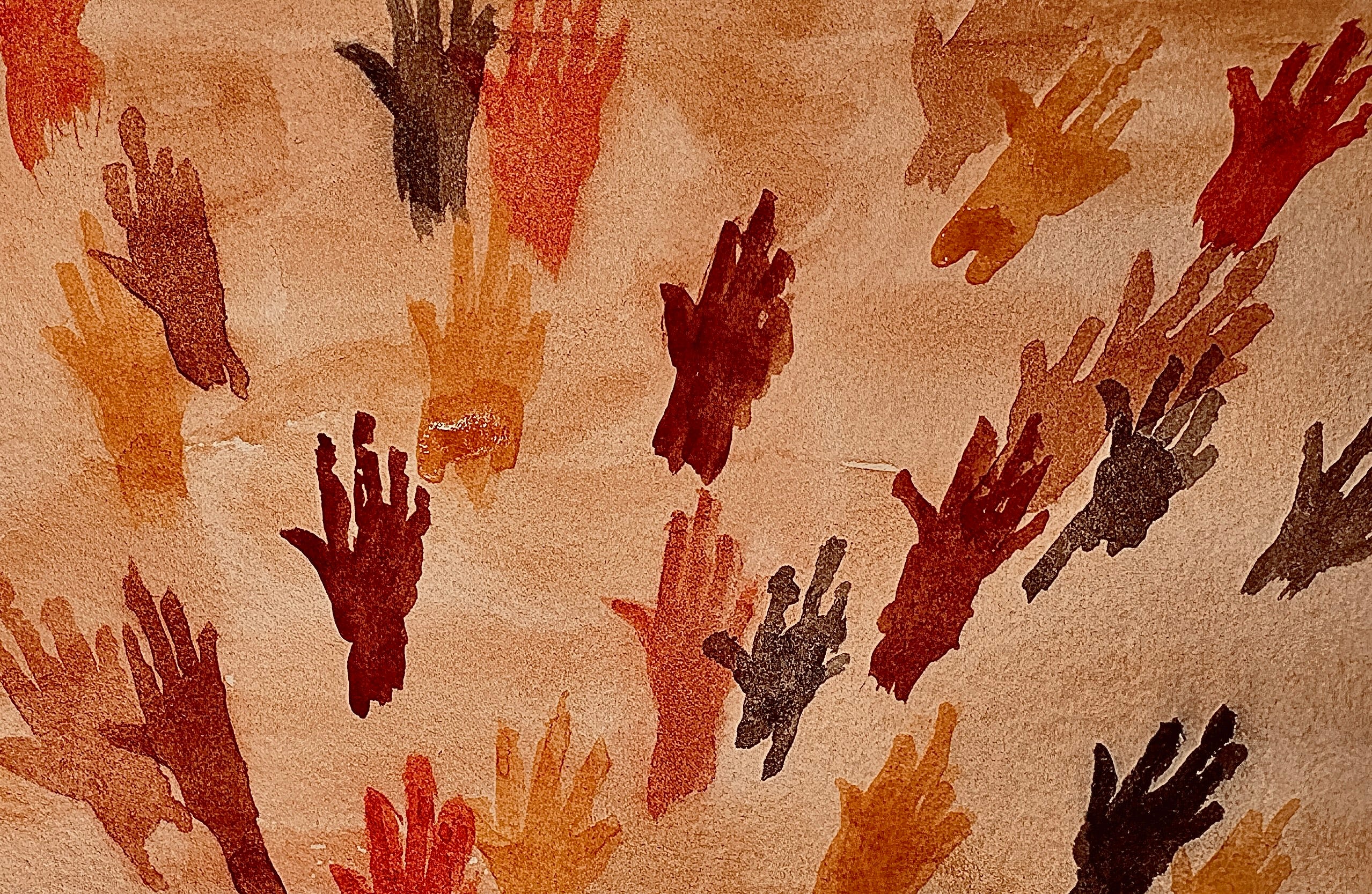
Something about this revelation made my brain flash and then explode, as if I had been struck by lightning. Drunk and high and pent-up, my thoughts went into overdrive. Perhaps God cast Eve from the Garden not for gaining knowledge, but for leaving a mark on his perfect creation by taking a bite from the apple. Eve was the first artist, and for this, she was damned. There is an even more ancient heretical story about the Cueva de las Manos, a work that has endured since the dawn of human art. The story, passed down to me by an old anthropology professor (as told to him by a heretical shaman), goes that the men who stenciled their hands on the walls of the cave were not laying claim to the world, expressing their existence over the eons, nor engaging in a shamanistic ritual, but rather because, so the story claims, they were committing a continued act of heresy. The earth, our mother, our prison, had trapped man on the earth, where we would be tempted, we would suffer, we would grow old and die — an endless loop. The heretical artists of the Cueva de las Manos stenciled their hands on the cave wall, on the very matter of the earth, as a warning, as a cry of despair: We’ve been here, too. Quod sumus hoc eritis. What we are now is what will you be. The hands reach out only in agony.
The revelation about Otto hit me the next morning. Hungover, bleary, and exhausted, I realized if the Covid testing facility had caught him on camera breaking isolation to vandalize the university, then I was on camera, too. And unlike Otto, I didn’t even do anything artful — I just destroyed random shit. I would surely be suspended. My brain started working in foggy overdrive: my parents would disown me, my brother would disavow me, my friends would pity me. I was a criminal. I had broken Covid isolation and destroyed random shit. What if I had spread Covid to an immunocompromised grandma while out smoking on campus at 1 a.m? What if she went back to her immunocompromised grandma care center and spread it to hundreds, thousands, even millions, of grandmas? How many would die because I had decided to smoke weed and drink? I was a killer. And I didn’t even create a beautiful work of art. No, I just destroyed a random sign. I was an idiot.
I hardly left my room from that point on. I couldn’t sleep. Feeling like Raskolnikov, I was overcome by immense guilt. I nervously awaited the police to come knocking with my suspension papers. All through the day and night, I would listen to the man in the room next to me screaming incomprehensibly, in words that likely no one understood, for seemingly no reason at all.
I wrote a lot. I scribbled poems in my notebook. I painted. I drank. I hardly left my room. This was my punishment, indeed this was man’s punishment: to be imprisoned for no reason at all, and then to die.
Then my isolation was over. I never got in trouble for breaking the sign. One day I got an email that I was free to return to my regular dorm, a dorm that was half-empty, to classes that were prerecorded, to dining halls where conversation was mute. But I was free.
Lately, I’ve been thinking about how memory operates and what it means exactly to recall the past. In trying to recall the pandemic years as a college freshman, it often feels like I have to, by necessity, speak falsely. This era is one of the most difficult to properly reconstruct. I am not sure if I — being unvaccinated and having caught the first variant (which was supposedly the strongest) — had experienced those strange symptoms sometimes ascribed to Covid: brain fog, memory loss, confusion, and idiocy. It’s hard to remember much of anything from that period because it is all shrouded in mist — although I must add that, for reasons I cannot entirely know and probably never will, most of my childhood is like that: not just forgotten but unremembered, taken out from my brain and shoved somewhere deep in my heart so that the memories of almost my entire childhood are inaccessible, shrouded in darkness, and mute.
Memory and experience have an uneasy relationship. Transforming experience into memory is like trying to translate an abstract painting into language. These things do not coincide; one cannot be expressed through the other without being changed or destroyed. The only true map of the world is the world.
To me, those ten days in isolation are a good representation of how experience operates. Those ten days were a kaleidoscope of emotions and energies, all bizarre and fantastic. If reviewed and spoken, they can only be reviewed in the fictions of memory, in the fumbling mistranslation of language. It’s like inspecting a kaleidoscope through the lens of the telescope.
Those times were strange. They were like a mass psychotic episode. However, experience itself is strange. You wake suddenly out of darkness to be confronted by a confusion of lights, shapes, colors, sounds, and emotions that, when too closely inspected, all seem senseless, fantastic, absurd. True experience itself is psychotic, especially when you are confronted not just with the confusion of lights, shapes, colors, sounds, and emotions of your bedroom upon waking but must also go out and confront other people — a whole world of other people — who are all babbling and acting and trying, in their own fumbling ways, to make sense of the psychosis of the world. Those ten days of isolation pushed me into a state so close to the raw, bloody, beating heart of man that I could touch the nerve endings of the soul and feel my own psyche light up in an ecstatic agony.
Nothing made sense then, neither does anything really make sense right now, as I type this. It is only through the careful application of the backward-facing telescope that we can study past experiences, transforming experience into memories, and memories into fictions. How do you make any sense out of the absurdity we all witnessed then, in 2020, or just now, as you read this sentence? How can you really explain what you just felt, what you just saw, what you are thinking now? It all must fit into the telescope of memory, or be lost.
The astronomer, pointing his telescope to the stars, can only see what happened millions of years ago. The astronomer is a historian of the soul, the constellations poems of our experience. Kneeling before the long slender tube of the telescope, the astronomer opens his mouth not exactly in prayer but expecting some kind of other Host.
Ezekiel ate the Scroll. We eat the past. The world eats us. Time devours the world.
Peace and Love,
Will Diana.

POSTSCRIPT
*What follows is a conversation between Will Diana and the founding editors of The New Critic.
Our essays are always online and always free, but we rely on individual donors to support the magazine.
Postscript, our author interviews, can be accessed with a paid subscription. The $30 annual rate costs as much as a couple paperbacks or movie tickets. Our $250 founding members are our most ardent patrons, those who wish to advance our wildest editorial ambitions.
In our conversation, we examine the origin and future of the author’s writing, the shadow world of Covid in 2020, Will’s fantasies of trekking across the globe, and his recurring dream about the moon of Ganymede.
Below is just a taste.*
ELAN But how do you deal with the anxiety of influence? Because it seems like there’s none. There’s no anxiety of influence. But then, Harold Bloom would say that’s a weak writer. I’ll put it this way — Rimbaud, let’s take Rimbaud. How oppressive is the greatness of Rimbaud and Nabokov to you? That’s the question.
WILL I think they’re useful starting points, but I want to get to the point where I strangle them.
I think that’s kind of what the writer is all about. It’s sort of like a duel between you and the people you’ve read and been influenced by. In this duel, you line up against the past great writer, but you get to see their moves ahead of time, all lit up and numbered, so you know what their moves are going to be in the duel. And their moves are really good. They’re so good that it’s really hard to beat them, even though you know where they’re going to step and when. And the first hundred times you line up against them in the arena, with the stands above lined with people cheering for blood, the past writer’s moves are so good that you get gutted in front of everyone.
Then you really study the moves, you learn how the steps operate, you learn the meaning behind the stances and the parries and jabs. Then you go again, and you still get gutted. You get gutted a hundred times, a thousand times, and everyone is cheering for your blood the whole time. But eventually, you keep going and going and going, and then you do beat the past great writer. And you get the satisfaction of driving the silver dagger straight into their heart. That’s when the writer has transmitted this idea, it’s been sublated into something greater. And that’s what I would like. I want, at some point, some other writer to do that to me.
THE YOUNG AMERICANS
 | A guest post by
|