
End Times
“Gasda’s bubble of hope in the BCTR is not enough to support all of our futures, maybe just his and a few beautiful actors.”

THE NEW CRITIC
Zayd Vlach is a 23-year-old living in New York City. He went to Deep Springs College and Swarthmore College and sometimes writes on his website.
I moved to New York in September. Someone moving to New York should have a good reason. Our great cities are difficult to live in. They’re expensive, unnaturally big, and they destroy any sense of peace. But even Los Angeles is heaven on earth, surrounded by perfect weather and the Pacific Ocean. New York is a steaming cesspool of the worst things in the world with only the trash-filled Atlantic for escape. One has to want New York’s highs badly enough to wade through the shit to get there. The highs could be publishing, or writing, or djing, or dancing, or maybe most generally and ambiguously, being in the scene. Honestly, I don’t think I’m going to last here very long.
The scene is hard to pin down, especially if you’re as lame as I am. Right now it seems to stretch from lower Manhattan, which has seemingly never stopped being the coolest place on earth since it started fifty years ago, to Bushwick. The last time the scene was concentrated enough to be named, it was called Dimes Square, although now that name and that scene have played out and become ironic. Dimes Square coalesced around 2020 in the space between the Lower East Side and Chinatown. It encompassed magazines (The Drunken Canal, Interview Mag, Heavy Traffic Mag, Sex Mag, Mars Review) and new social media platforms (Perfectly Imperfect, Urbit), and had its heroes, too (Sheila Heti, Tao Lin, the Red Scare girls, Peter Thiel). To anyone even slightly more involved than I am, this list would show exactly how little I really know. But that’s okay. I suspect that the readers of the New Critic know even less.
Immediately upon my arrival in New York, I was confronted with my own lameness. My job’s training site was on Catherine Street, and on my lunch breaks I’d wander up to Canal and Essex, imagining the lives of the people who passed me — maybe artists or writers or models — all likely tapped into a cooler cultural moment than I’d ever be. I went to some readings, awkwardly milled around afterward, accompanied my artist friends to a few gallery openings, and nervously watched gay men talk shop in front of glitching CRT monitors and washed out canvases. I needed a way in.
Two years ago, my ex-girlfriend spent a gap year living in New York. She was fairly depressed and unproductive, but to her credit, even at her least driven, she accrues cultural capital more ambitiously than I can ever hope to. She spent days scouring Instagram and various trendy websites, determining what was the coolest thing happening that night, how she could go, and who she should talk to there. Unsurprisingly, she was interested in the mysterious Dimes Square scene; she had already been primed by years of devoted Red Scare listening (one of the first ways she wooed me was by wearing her Red-Scare-merch-thong instead of her normal Target boxers around our dorm when we were eighteen).
Once, when I took the bus from Philadelphia to visit her in New York, I saw a new book on her shelf: Dimes Square and Other Plays. I, maybe only knowing that the term signified something cooler than me, asked her about it. She said she had bought it after she saw a play by the author, Matthew Gasda. I was hooked. She was scene chasing, I was scene chasing through her scene chasing, and we struck a deal that she would give me the book after she finished reading it. I doubt she ever read it, and I took the book off her bookshelf when she wasn’t looking a year later.
We broke up soon after that, and I was stuck with the book for good. I dutifully brought it with me to New York this summer. Searching for a way into the scene, I looked up at my shelf and looked up Matthew Gasda. I found he ran an independent theater production company, the “Brooklyn Center for Theatre Research” (BCTR). I learned that if I paid him $225, I could take a playwriting class with him. A few weeks later, I took the 6 train to the E train to the G train and got off in Greenpoint. The final recourse of the lame has long been shelling out.
Gasda is a 36-year-old playwright from Bethlehem, Pennsylvania. Bethlehem is a small town next to Allentown, which is a suburb ninety minutes north of Philadelphia and ninety minutes west of New York City. He calls it a steel town. He has been writing plays for a decade but got his break during Covid. When everyone else agreed to stop seeing each other, Gasda decided to start staging his plays outdoors and, too quickly, indoors.
I read his play Dimes Square and his recent novel The Sleepers before our first class to prepare. Dimes Square is about the relationships between a cancelled indie musician, a newly successful filmmaker, a model, an aging literary critic, and other archetypal scenesters. Little happens in it, except for large amounts of coke and barely consensual sex. The play was staged in various downtown lofts and cast with Gasda’s friends, Dimes Square people who frequently played themselves. The Sleepers is about a variety of failing relationships, including a long-term romantic partnership, a student-teacher fling, and a pair of sisters. Slightly more things happen in The Sleepers than in Dimes Square.
The first thing I noticed about Gasda’s writing is how contemporary his plots are. He wrote about Dimes Square as it was happening, earlier this year he wrote about a Sam Altman character, and I believe right now he’s drafting a play about Bryan Johnson, the man who is filling himself with his son’s blood and measuring the frequency and intensity of his nightly erections on YouTube to prevent his own aging. While most artists tend to be cautious about blatant cultural artifacts dominating their works, for fear of being dated, Gasda embraces the present moment. And while The Sleepers is not as blatantly about current phenomenon as Dimes Square is, much of it takes place over stylized text messages, and it relies heavily on current social stereotypes and cultural touchstones — like hipsters living in Greenpoint or the kind of academics who are regularly published in n+1. Gasda doesn’t seem to imagine himself writing plays that will be read forever, but rather immediately.
During class, Gasda repeatedly emphasized that art, plays specifically, must have a dramatic beat that pushes forward. I think it is this dramatic beat that makes a play his preferred medium for exploring current phenomena. Time marches relentlessly forward in both plays and in life, making each moment before the present one irrelevant, making the play irrelevant itself.
The second thing I noticed about Gasda’s writing is how depressing it is. It is so nihilistic that it is hard to imagine that there will be a world around after tomorrow to read his plays at all. Gasda never gives us a solution to our problems or even a reason to hope. Dimes Square offers no way out for any of its characters. The most common refrain in the play is, “We’re living through the dumbest time in human history,” and there is little in his work to complicate the truth of that statement. Here is a snippet of a conversation between two girls, one a newcomer to the scene and one a veteran, the morning after a party:
ASHLEY
Can I ask you a question?

ROSIE
Sure.

ASHLEY
Should I like really invest time in his world?

ROSIE
Absolutely not.

ASHLEY
Why do you say that?

ROSIE
I think it’s self-evident.

ASHLEY
You’re all hot and cool.

ROSIE
It’s a bunch of social climbers railing coke at 4 a.m. shitting on their so-called friends.

ASHLEY
That’s bleak.

ROSIE
This whole group of people is not going to be hanging out in a year, let alone six months. It’s rotting.
The Sleepers is even more depressing — ending with a suicide and no picture of a healthy relationship or fulfilling life — and more universal. It relies less on its exact moment or location and could reasonably be set anywhere, at any time, with a similar cast of miserable people, although with fewer long and embarrassing text exchanges.
Beyond how depressing the work is, Gasda also disregards art’s common purpose to tell us how to live. While Tolstoy’s inability to keep his preaching in his pants nearly ruins Anna Karenina, I find it difficult to surround myself with hopeless art. I want the art I consume to increase the amount of awe I feel in the world, to make life feel thicker and less knowable, and to further encourage living tomorrow. Gasda’s most famous works do none of that. After watching Dimes Square or reading The Sleepers, I struggle to find a reason to embrace life or more art, and the world feels increasingly reducible to clichés. Gasda’s writing even lacks beauty in form, which otherwise could lessen the blow of the content. His language is direct and common, and his images are meager in beauty and quantity. After I finished The Sleepers I sat silently looking at my shoes and feeling nauseous until I got to my subway stop. When I got out of the train, the sun didn’t feel as warm as it had earlier.
None of this is to say that his art is bad or that Gasda is unskilled. Creating genuine misery is no easier than creating joy, and Gasda has carefully listened to the disquiet of his world and reflected it back to us.
It is worth emphasizing that Gasda is reflecting his own world and his own friends. He only wrote Dimes Square because he was in the scene. The Sleepers is almost exactly about the people who live next to him in Greenpoint and who watch the shows at the BCTR. He seems to rejoice in the meaninglessness of our time, of his own community, and of his own life. What kind of person does this?
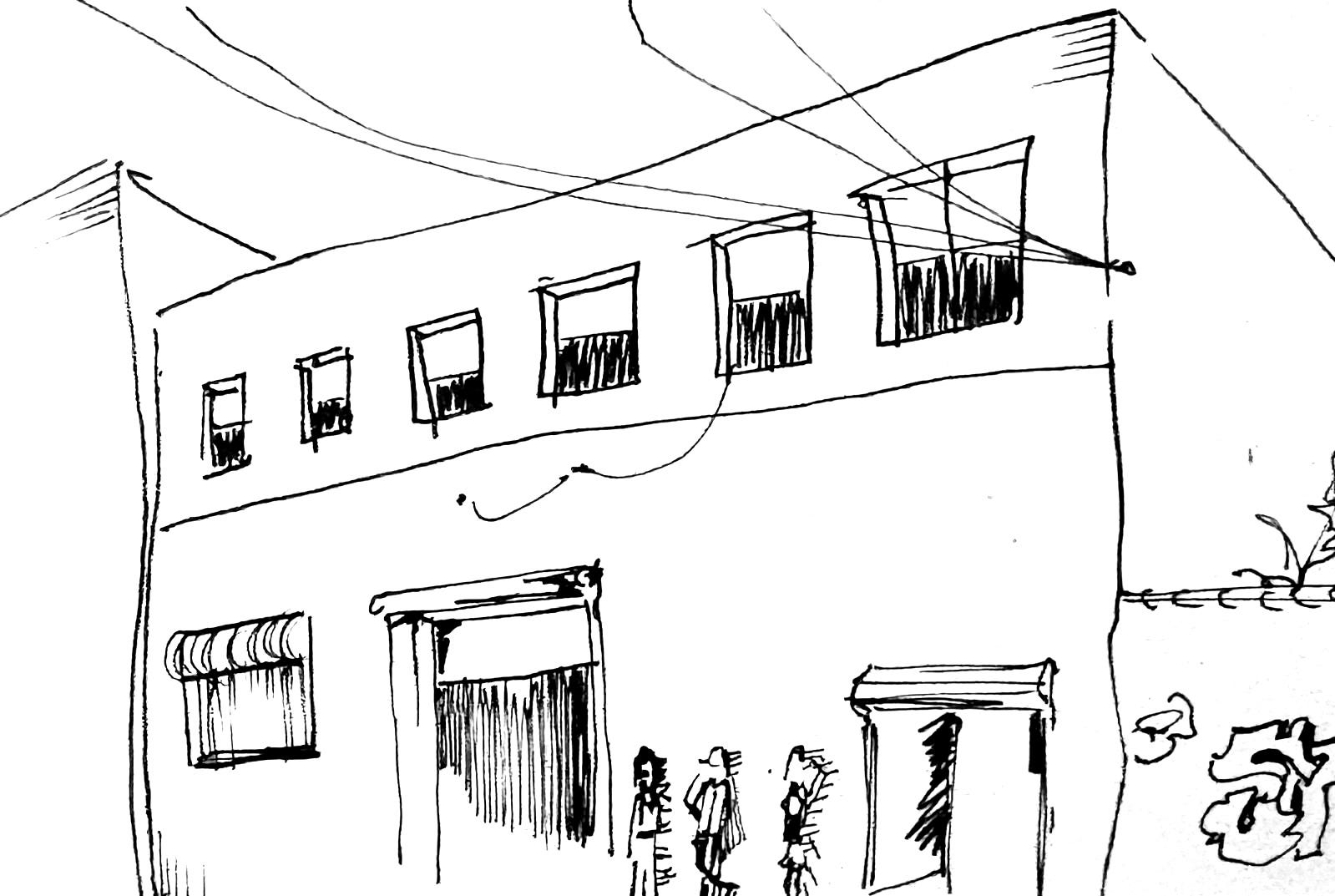
I arrived for my first class ten minutes late. The BCTR is in one of the few industrial and unfriendly pockets left in Greenpoint. It is surrounded by fabrication shops, construction storage sites, and warehouses. It is in a large white building that is completely unmarked except for the address next to the door. Despite the building’s anonymity, its identity was immediately revealed by the three beautiful people standing next to it with Freitag messenger bags, bleached hair, and Doc Martens. After nervously nodding to the people cooler than me, already sure I had been found out an imposter, I unlocked the door with the code Gasda’s assistant had emailed me earlier that day and walked up the stairs, through the foyer full of zines, the kitchen and the bar area, and into the theater.
The theater is full of a random assortment of used chairs in every possible style, and its walls are covered in kitschy paintings. While I might be able to recreate the look after raiding every thrift store in a twenty-block radius, I don’t think I could create the same feeling. It is as if Gasda started with one chair, then went out and got another one when it was needed, and repeated this process forty separate times with forty different kinds of chairs. Similarly, the art throughout the room seems like it was acquired piece by piece whenever a new production demanded a new kind of painting. Such processes seemingly continued until the room was left with an assortment of objects that feel infinitely practical and completely unplanned, like any play could be reasonably staged here with enough ingenuity.
My peers — two girls, two feminine non-binary people, and two boys — sat sprawled atop a Quaker staked chair, a fainting couch, two classic American bar stools, and assorted ottomans. Three of them had worked for Gasda previously, as actors in different past and ongoing shows. This was obvious due to the way Gasda incessantly made fun of them. As he warmed up to me over the course of the class, he mocked and berated me more and more. We all have different ways of saying “I love you.” The other pupils ranged in age from 24 to 36. All of them, besides me and one other classmate, were already involved in theater or screenwriting. Most of them were beautiful and intimidating. Gasda was sitting in the front of the room on a couch. He had beautifully styled hair that he raked back intermittently as he talked. He wore a light red cashmere sweater and thin-rimmed glasses. When he opened his laptop, I saw that he uses a red-light filter that makes his whole computer screen almost unusably red and dim.
After introductions (Hi, my name is Zayd. I graduated from college in May, and I just moved to the city a few weeks ago. Oh, where are you living? East Harlem. Oh, haha, maybe consider Brooklyn. Yeah, definitely. Um, I also have never written a play, or really anything creative. Cool. I’m very excited to be here. Welcome!) we launched into a brainstorming session. Gasda asked us to think of a title and then a list of characters, an estimated length, an estimated cost of production, a rough outline of the play’s acts and what would happen in each of them, and then a moodboard for the play, including a song, a philosopher, and a color. Most of my peers already had fully formed ideas or half-written plays. I had spent the last two weeks racking my brain to prepare for this moment, and the best idea I’d managed was a play about someone having a breakdown during a work shift in a café. On the way out of my apartment that morning, my roommate suggested I write about the ranch where we met. Unable to think of anything better on any of the three subways I took to Greenpoint, I listed three characters that were just my friends, wrote “Kierkegaard” as the philosopher, and suggested tan and muted green to correspond to the desert and the sage brush of the ranch.
My mediocre play outline was discussed for a few minutes before we moved onto my peer’s better idea about a family clearing out their grandmother’s house in the desert after her death and getting slowly overwhelmed by the amount of dust that’s stirred up. At our third class a few weeks later, after having written around 5,000 words of my play, Gasda and my peers read it. Gasda said I could write natural dialogue, which he claims is most of the battle, but that my play needed to have stronger dramatic movement. He seemed surprised by the quality of my writing and was substantially warmer to me, giving the criticisms I shared in class greater thought after reading my draft. He also liked the play’s simplicity and low cost. The whole play takes place in the same setting, which is just chairs around a low table. On our first day of class, I estimated the play would cost $500 to put on.
Gasda is a playwright, but he is also an entrepreneur. The rent for the industrial loft that the BCTR is housed in is such a tight squeeze that sometimes actors have to wait months to get paid for performing. I learned this from my classmate who was himself waiting for Gasda to pay rent before he could get paid. This entrepreneurial spirit, combined with a belief that plays should have a rhythmic, dramatic heartbeat, means that Gasda is not at all interested in abstract plays that are too unwieldy to easily perform. The most blunt advice he gave us was to keep our plays as simple as possible. Cheap, simple plays get put on. Expensive, complicated plays get passed on.
To his credit, Gasda is serious about performing the plays that students in his courses write. He is willing to do revisions and line edits of finished drafts, and he frequently holds readings of students’ plays at the BCTR and was even working toward a full production of a student’s play while teaching our class. This dedication to putting on people’s plays and bringing on new actors means that writers and actors who have been spotlighted and supported by Gasda are loyal to him. When you walk into the BCTR, it feels like you’ve entered a universe that orbits around Gasda. Beautiful twenty-something-year-olds are deferential to Gasda, everyone laughs at his jokes, we wait on the edges of our seats for his opinion, and I have never heard anyone disagree with him.
Gasda seems to revel in this — who wouldn’t? He laughs freely, he walks around unencumbered, he shares his opinions with a rare authority. He is a king in his castle. I love it. There is a unique joy in being with someone who knows what they’re doing. Too frequently, I am surrounded by people like me, people who know nothing about anything and act like they have been let loose in a room with the lights off, waddling around the world with their arms out in front of them, trying to feel out the next obstacle, always about to to trip and fall. I am skeptical that Gasda’s expertise extends very far beyond the door of the BCTR, but inside of it, he dances and twirls perfectly. He drinks and smokes and laughs and socializes and charms and directs and berates and brushes his hair out of his face, all with perfect grace.
In the middle of our first class, Gasda brought a gallon of water into the room along with several glasses. Every Sunday, he receives a delivery from a community supported agriculture goat farm in Pennsylvania’s Amish Country. He gets a gallon of goat milk, yogurt, and kefir, and a gallon of water from their well. Gasda drank a glass of goat kefir and offered a glass of pure non-city water to us. We all drank some, and my peers excitedly talked about how good and clean it tasted. Normally, we drank water filtered through a large Berkey filter in the BCTR kitchen, a water filtration system that uses only metal parts and is currently engaged in litigation with the EPA over fraud claims. Gasda nodded in agreement about the cleanliness of the water and talked about microplastics.
Gasda is not a person who has given up. His art seems to have accepted the fact that we’re living through the dumbest time in human history, but he is clearly fighting upstream. Why keep writing plays? Why found your own theater? Why continually recruit new talent? Why work so hard to limit your microplastic intake? Why use a red light filter to improve sleep quality and focus? An aging novelist in Dimes Square says, “The world is changing, man. If you wanted your kids to turn out like you, you shouldn’t have had kids.” In another, far bleaker, exchange between a young artist (Rosie) and an old editor (Chris), the old editor clarifies what he means when he said one young author wasn’t like the rest of their young peers:
Rosie
What’s like the rest of us?

Chris
Incapable of truly astonishing.
But Gasda is not dedicating his life to the pursuit of mediocre art. He is recreating the world in his image, shaping it with his tastes and desires. He is pursuing greatness. In an industrial loft in Greenpoint, the future is bright.
Recently, I’ve been less sure than ever about whether or not I want to have kids. I’ve spent the last few months working with five- through ten-year-olds. I really like them. They curse at me, throw trash cans across the room, hug me in the halls, put stickers on my face, draw cruel caricatures of me, make jokes, growl, skip uncontrollably, and feel every single emotion stronger than I do. They are magical, and I love us together, and I love the future. Like a woman approaching thirty, I am sometimes overcome with baby fever. I saw a mother walking down the street with her twins and all three were wearing identical down jackets. I almost burst out crying.
Despite it all, the thought of having a child feels absurd. I suspect the way I will eventually end up with a kid will be by accident. A woman I had sex with will get pregnant, and we will both feel neutral on the subject, and then eight-and-a-half months later we will have a child. People who believe the world will continue plan to have kids. They “try” — a hilarious turn of phrase — and paint their nurseries.
I don’t feel any anti-natalist sentiment; I just feel unsure. I don’t believe the world is bad, or that to bring a child into our world is to do that future human a grave moral wrong. I love our world. Suicide is completely mystifying to me. I suspect when anyone jumps off a bridge they must think to themselves as they fall, “I wish I had had a few more minutes.” But I feel tremendously uncertain about what lies before us.
Matthew Gasda doesn’t have any kids. I don’t think he could write most of the things he currently writes if he did. Our children’s futures can’t be contained to a glimmer of hope in an industrial loft in Greenpoint. For one, developers are bound to buy the building and turn it into luxury condos or a new Equinox before they grow up. And, more generally, Gasda’s bubble of hope in the BCTR is not enough to support all of our futures, maybe just his and a few beautiful actors.
A few weeks after the program ended, Gasda emailed me, telling me to send him the draft of my play when I finished it and inviting me to a reading of a new screenplay at the BCTR. Flattered, I got back on the 6, transferred to the E, then to the G, and walked into the theater thirty minutes late, halfway through the first act. As I shuffled through the audience looking for an empty seat, I knocked over a woman’s Diet Coke. She looked at me in annoyance with incredibly piercing blue eyes as I fumbled to pick it up.
Gasda lounged in the corner. He coached actors through the readings, corrected pronunciations, queued the music, and gave minor notes about how he imagined the characters would act. The play was funny, and no one laughed harder than Gasda did.
After the reading was finished, people talked over glasses of natural wine. Gasda introduced me to others as “a humble and promising talent.” There was a four-person line for the bathroom, so I left the theater, snuck into the construction site next to the BCTR, and peed on an orange cone. This, combined with my general feeling of being out of place at the party, made re-entry too much to bear. I took the G to the E to the 6 back home.
I couldn’t place the blue-eyed girl until two days later when, swiping through my Instagram stories, I realized she was Claire Banse, a founder of The Drunken Canal. All of a sudden, alone in my room, I realized how deep in the scene I had briefly been. The people Gasda had introduced me to were featured in Banse’s first three Instagram posts. They were actors, writers, and musicians. I had been surrounded by Dimes Square, I had briefly been a minor character in one of the play’s living room sets. I had found the very people, the very scene, I had, in some sense, come to the city to find. New York is the coolest place in the world, and I had stumbled into the middle of it for a night. And, in fine form, I had capitalized on this opportunity by arriving late, spilling Banse’s drink, mutely smiling as Gasda introduced me, and leaving before meeting anyone, only to urinate in public.
I don’t think I’m going to last very long in this city.

THE YOUNG AMERICANS
 | A guest post by
|
Fantastic on-the-ground reporting of a scene about which we're all surely curious. Good luck in the city
comment