
Commute Cursed by God
“Most American drivers experience three to four car accidents in a lifetime. That leaves me with two lifetime supplies...in two years.”

THE NEW CRITIC
James Milstead is a 21-year-old undergraduate studying English and Linguistics at the University of Texas at Arlington. He contributes to the Substack and podcast O Reader, Where Art Thou?
Seven car accidents in two years: arguably the defining characteristic of my first years of college. Every time I find myself talking about driving (in the Dallas-Fort Worth metroplex, where spending hours in the car on commute is a religious act, driving comes up often) mentions of an accident slip into my conversations. Even conversations that don’t involve cars at all lead me right back to the accidents; if you ask me if I remember when so-and-so happened last spring semester, I’m compelled to locate the event in my memory in reference to whichever one of my crashes is chronologically nearest, reliving the howl of wheels and crunch of fiberglass, before being whipped back into the present moment to produce an answer, “Yeah, of course.”
I have difficulty understanding the winced looks I receive when I explain my driving history. I simply don’t know what’s an acceptable number of crashes anymore. I did look it up once to see how many accidents the average U.S. resident experiences per year; one law firm’s website stated decisively that most American drivers experience three to four car accidents in a lifetime. That leaves me with two lifetime supplies of crashes in two years. That number doesn’t bother me, in part due to the completely warped perception I have of appropriate car crash tallies. Still, grasping at rationalizations for such an unfortunate streak is a now-familiar movement, as I find myself casually mentioning my driving record and then feeling the need to defend myself from people’s inquiring eyes. “Do you know how dangerous the streets of the metroplex are? Do you know that I used to drive most of the way across the metroplex to get to the university every weekday? Even cutting it down to a three-day week didn’t save me from getting in wrecks. Just a one-way trip is 45 miles. All that time and all that distance on the road add up, so statistically it makes sense that I’d have a few mishaps. Plus, only three of the accidents were my fault, legally speaking…”
Though I never quite seek vindication, having lost the will to harbor strong feelings toward that number or other people’s perceptions of it after the first year of crashes, I understand the suspicious look they give in response to my tired speech as the indication of a thought they always seem reluctant to share: maybe you’re just a bad driver. I don’t blame them for the thought. I wouldn’t even deem them incorrect. Yet I feel a pang of offense. I want to say that I’m more than just a bad driver, I’m in the worst circumstances you could put a driver like me in. The bad driver label doesn’t consider my conflicted understanding of what my accident history is, what meaning any of it has. You don’t understand: this commute cursed by God is driving me crazy, and the sum total of the wrecks I’ve had is the least pertinent point to my mind.
My life as a commuter began as all good adventures do: in absolute mundanity. I’d just opened a Faustian contract with the highway that I thought would save me a lot of money and stress, exchanging a little time in the car each day for the privilege of free college and a free place to stay. At first, getting used to the act of driving to and from the university wasn’t the most difficult part. It was at most like a household chore; dropping a plate while loading the dishwasher and dealing with a manic driver on the highway dealt me an equivalent amount of frustration. No, the greatest struggle was deciding what else I could manage to do during the two hours I was locked away in the moving cage each day, a prisoner deciding how to pass his sentence. Too quickly, I grew accustomed to the rather uninteresting sights along the 45-mile stretch of road — the undulating, green plains occasionally interrupted by a gas station decorated in Christmas lights or a horribly ugly, brick-like Church of Christ. Soon after taking up the commute, I refused to settle for staring out the window (though staring out the window shouldn’t really have been an option anyway, as it is in those moments of distraction that the renegade motorists strike).
As the weeks went on, the seven o’clock grogginess clouded my brain and killed any desire to concentrate on listening to the individual parts of a song I’d never heard before, the interlocking guitars and drums and vocals; by the evening, I was just as tired as I’d been in the morning. So I went back to that which required less thought, the same three CDs stored in my glovebox. The commute was already repetitious, but this routine exacerbated the monotony. I’d get in the car, and my eyelids would already be slumped over my eyes. I wished I could shut my brain off for the entire drive and wake up at my destination.
The first accident was one of those fender benders that every parent wants their child’s first accident to be. As I was driving home after class on an October afternoon, there was a car at the stop sign in front of me that pulled out a little bit into the street before suddenly stopping again. I’d glanced down at my GPS to check which direction I needed to turn, and before I could look up again, I heard the fiberglass of my bumper cover crackle as it ground into the car in front of me. We pulled back so her car wouldn’t be halfway into the street and exchanged information while I sweated buckets in the sun (though I wasn’t sweating because of the sun). During the exchange, I couldn’t stop pacing, because if my body stopped moving, I’d certainly explode. The mild tap of my car against another’s had filled me with an exhilaration I’d only experienced while waiting in line for a rollercoaster. I had to shake the stutters out to the driver as I asked if she was alright, and what insurance she had, and all the things I’d been told I needed to say. In my mind, I sang along with Jake Ewald:
I’m all thumbs today
I feel young in a bad way
Before I knew it, we’d said what we’d needed to say, and she drove away. Her bumper was barely scratched, but she still filed an insurance claim.
The thing about rollercoasters is that the ride itself eventually provides a chance to break the tension in an explosion of energy, replacing that suspense with an entertaining type of terror. In my case, there was no release. The wreck was the cause of the tension rather than the break. The disruption burst into existence for a brief moment and then subsided quickly, leaving only nervousness in its wake. After the crash, there was nothing but the hour-long trek back home in a slightly more battered car and the collapse into bed at the end of the afternoon. For the next few days, the storm cloud of bureaucracy hung over me as I began the drawn-out process of delivering my account of the accident to the insurance agency and receiving the politest notification of bad news they could give me. The static nervousness persisted for a while then gradually faded into the background, almost like the droning hum of the road. “I got lucky with this one,” I told myself at the end of the ordeal, “but I can’t afford anything more serious than that, so I’ll have to be careful from here on out.”
But trying to stay alert didn’t save me from a second accident. And it didn’t matter much that it wasn’t my fault. When you’re in a serious accident and there’s a child in the other car, you don’t stop feeling sick. You double, triple-check to make sure that, yes, that really is the front of your car hot and melted into the rear passenger-side door of the car in front of you, and yes, that is a child in a car seat on the other side of that door. You fumble with your seatbelt, and you leap out through the door and run toward the other car now fused to yours, calling to ask if they’re alright. And the mother comes out, too, and you hear her say, “Oh my God,” and that makes you feel sicker.
And when the off-duty police officer who was in traffic behind you steps out of his car and tells you that it’ll be alright, and it’s not your fault, you don’t stop feeling sick, but now it’s because you no longer have a functioning car, and you’ll have to figure out how to drive to the university for the next week or so while your car’s in the shop, and not only that, but you have to go through all that bureaucratic nonsense again and haggle the insurance agents until they relent and pay to get the car fixed. And your monthly insurance payment will go up again, and after thinking all that, you feel even sicker knowing that you feel more upset about the hassle of crashing your car than you do about coming so close to killing a child.
From that point on, it seemed that every move I made was a scramble to patch up holes in the least seaworthy ship on earth, if you’ll allow me the one nautical metaphor. Music became a method I used to keep myself alert as I drove. I no longer valued albums for their depth or novelty (which deeply injured that part of me which longed to be a snob) but for their ability to preoccupy my brain, keeping me singing or screaming along. I’d previously longed for numbness to last me the duration of the drive, but now it was the thing I did everything in my power to push away. With each successive wreck, the uncomfortable nervousness only grew more pervasive. Only the effort I made to drown out my paranoia, that reminder of crashes past and forecast of crashes future, made the journey bearable. It required a strict routine of putting into rotation those albums that could elicit a reaction from my brain without letting that rotation become itself part of the monotony — like squeezing a concentrated flow of music through a hose. But when you’re rear-ended by an absent-minded mother to the accompaniment of folksy guitar riffs, or you rear-end another car on the highway while screaming along to System of a Down, or the drunken owner of a high-suspension pickup truck smashes your car’s rear to bits and then speeds off into the night, leaving you alone with Jeff Buckley still crooning from the speakers, you finally realize that all that routine has little payoff. I was five accidents in, and music hadn’t done me one lick of good.
I remember driving home in silence on the night of the fourth accident (the incident with System of a Down, which was definitely my fault) after crushing my own front left fender and headlight against the other car’s rear bumper. I’d called my parents, who were at a party in a different town, to let them know that I was safe but my car needed repairs. I spent the drive home mentally killing myself over the fact that I had caused another accident, making life so much less convenient for the other driver, my parents (whose help I needed to find new parts for the car), and myself. The worst part was, I didn’t have a single strong emotion about it; if I felt guilt in my heart, it was only because I wasn’t feeling more guilty. Every few minutes, I slammed my hands into the rubber of the steering wheel to feel the sting against my palms. I let out the occasional yelp or scream, which was more performative than anything and gave me some way to release all that static emotion. Angry that I wasn’t crying about the mess I’d made, I screamed it out.
As my eyes drifted to the side of the road, to the ditches filled with dark grass descending into invisible depths, I asked myself, “What if there were no more crashes?”
With one final crash, there’d be no more car to worry about, no more mind-numbing commute, no more sudden moments of destruction to complicate everyone’s lives. With a flick of the wrist, I could veer off the road and careen into the ditch, all while screaming along with Sean Bonnette at full blast on the stereo,
No more bad times, no more bummers
No more SUVs and no more Hummers
As thrilling as the prospect sounded — and I did initially gravitate toward the idea for its seeming bombast — I realized just how little emotion the final crash generated in me. During Accident No. 3, I’d gotten rear-ended. In the milliseconds leading up to the collision, I stared into my rearview mirror and, upon seeing the impending car, I didn’t think, “God, help me!” or “What do I do?” Instead, I said aloud, “Not again.” It’s simply dropping a plate. In every subsequent crash, I’ve repeated the same mantra, occasionally accompanied by, “Oops, that one’s on me.”
So flying off the highway into the ditch provided no fiery glory and no release from the commute — it only offered more trouble for the people forced to clean it up afterward (I’d simply pass the burden of my commute onto someone else, like Atlas asking for a smoke break and then diving off a cliff). I balk at the idea that the sum of my accidents should matter to anyone, least of all myself, but the thought of preventing that number from ticking up further, of washing my hands of that number for good and rendering it completely meaningless, offered no appeasement. Even if I never had another accident and kept that number from ticking up while staying alive, I had no reason to believe the post-catastrophe nervousness would leave me; I might be stuck with the same lunacy as before.
After about a year and a half on the commute, I’d made it through five accidents — obviously playing music had proven to be of little help in both preventing crashes and distracting me from the nervousness — so to shift gears, I began to listen to audiobooks in the car. It began as an act of spite; upon seeing posts online of some people talking about how many classics they were getting to read in their spare time, I snidely said to myself, “Yeah, well, I bet you don’t have a two-hour commute.” I subsequently attempted to prove I could consume just as many classics as everybody else while on the road.
Eventually, I found my way to William Faulkner audiobooks. I was specifically captivated by As I Lay Dying, so much so that I immediately read the print copy after listening through so I could fully soak it in. I saw a symmetry between my commute and the Bundren family’s voyage. As the Bundrens set out across Yoknapatawpha County to lay their mother to rest, so, too, did I set out across the metroplex. I began to imagine myself driving around each day in a coffin very like Addie Bundren’s, excepting its velocity, size, and metallicity. Car and coffin became interchangeable in my lexicon. When referring to either object, I wouldn’t know which word I was about to use until I said it.
When I enter the coffin each morning, I consign myself to unbeing. Out there on the road, I’m in no place and am associated with no place — the people in the cars driving past know nothing of my home in a Dallas suburb or the university I attend in Arlington. The car crash is a concentrated form of this sensation: I am brought from catastrophe into nervousness on the side of the road. I step from side to side, restless because I need to be any place other than here, since then I’d actually be in a place and not the space in between places. To the people driving past, I’m just a person who got in a car accident, and to the person standing in front of me, I’m the person whose car they hit. I incur a loss of place and identity, the things that make me human.
When you’ve been in these circumstances, say, seven or so times, you start to pick up on a unique feeling of eeriness anytime you describe it to others. In my case, I begin with an awkward pantomime, and I end the story with utter frustration. I sense a gulf between myself and the people who don’t share my commute — they simply haven’t experienced the deathfulness of it. Even those who do, even those other students driving through the metroplex to get to another one of the hundred or so universities we have around here, might not have recognized for themselves the way the commute reduces them. It’s only those with an absolute hatred for the car that can truly understand, I think — those who, when the wheels roll to a stop, can’t stand to sit in their seat another second longer. Sometimes people just understand, and sometimes it takes surviving seven wrecks in two years to get it. And even then, if you put all of us who’ve been driven crazy by the road in a room together, we still wouldn’t quite know what we want to do about it. Experience tells me it won’t help much if we all set our Priuses aflame — that achieves the same end as driving them into a dark roadside ditch.
I guess I can only tell you what I’ve decided to do, which is to turn my back on the final crash entirely. Instead, my commute must be a sprint toward humanity. I must wake up every day thinking, “I won’t seal myself away.” Music and audiobooks are no longer mere stimuli to keep me alert or distract me from boredom but a method of desperately reaching out and asserting that I still belong to humanity, that I am still a part of the world despite my deathly state. I long to shrill with Evan Lescallette,
Of course it’s personal
Personhood has made me feel this way
I can’t afford to belong to a place — I can’t afford to stop going to university — but I can mentally attach myself to these songs and stories in order to belong to them. And because these activities can occasionally lose their edge and their grip on my brain, I’ve expanded my methodology. I listen to language lessons (right now, I’m working on my Japanese), which require me to respond out loud and involve a greater semblance of reciprocity than the act of listening to music (the music itself is rather indifferent to my screaming along to it).
Probably the most radical practice I’ve developed (and thus the most deserving of scrutiny) is actually speaking to someone, usually my girlfriend, on the phone while I’m driving. It can be a little tricky to do this in a safe and legal fashion, but I don’t think there’s a better way to strive to be a person in such an impersonal environment than by talking to someone else. Of course, this isn’t practical for every commute, especially for the person who isn’t spending an hour with nothing else to do but drive. It started out innocently enough, with the thought, “I should call my girlfriend while I have this free time.” I’m wary, though, of letting it devolve into merely using her to stay awake on a long drive. Still, I jump at the opportunity to have a human interaction from within the car. My hands are firmer on the steering wheel, and my eyes have a quick steadiness to them. Is it that I’m driven by a desire not to traumatize the person on the other end of the line? Maybe, but I don’t think that’s quite accurate. Perhaps it’s that interacting with a human comes more naturally than interacting with artifice, so talking to someone puts me in the right frame of mind without making me work as hard for it. Regardless of the mechanism, it works for me, in moderation. I’ve come to realize that the dead truly are grateful when we pray to them because I, too, have been grateful when my loved one speaks to me during my stay in the coffin.
On a cold morning in November, I drive to the university in a light rain. It’s darker than it usually is at nine o’clock, and a few droplets, each a miniscule car crashing into a glass wall, beat against my windshield. I see a dewy world painted with wet melancholy surrounding me during my long drive. The rain clears a little as I near my destination, leaving only a light mist hovering around my windows.
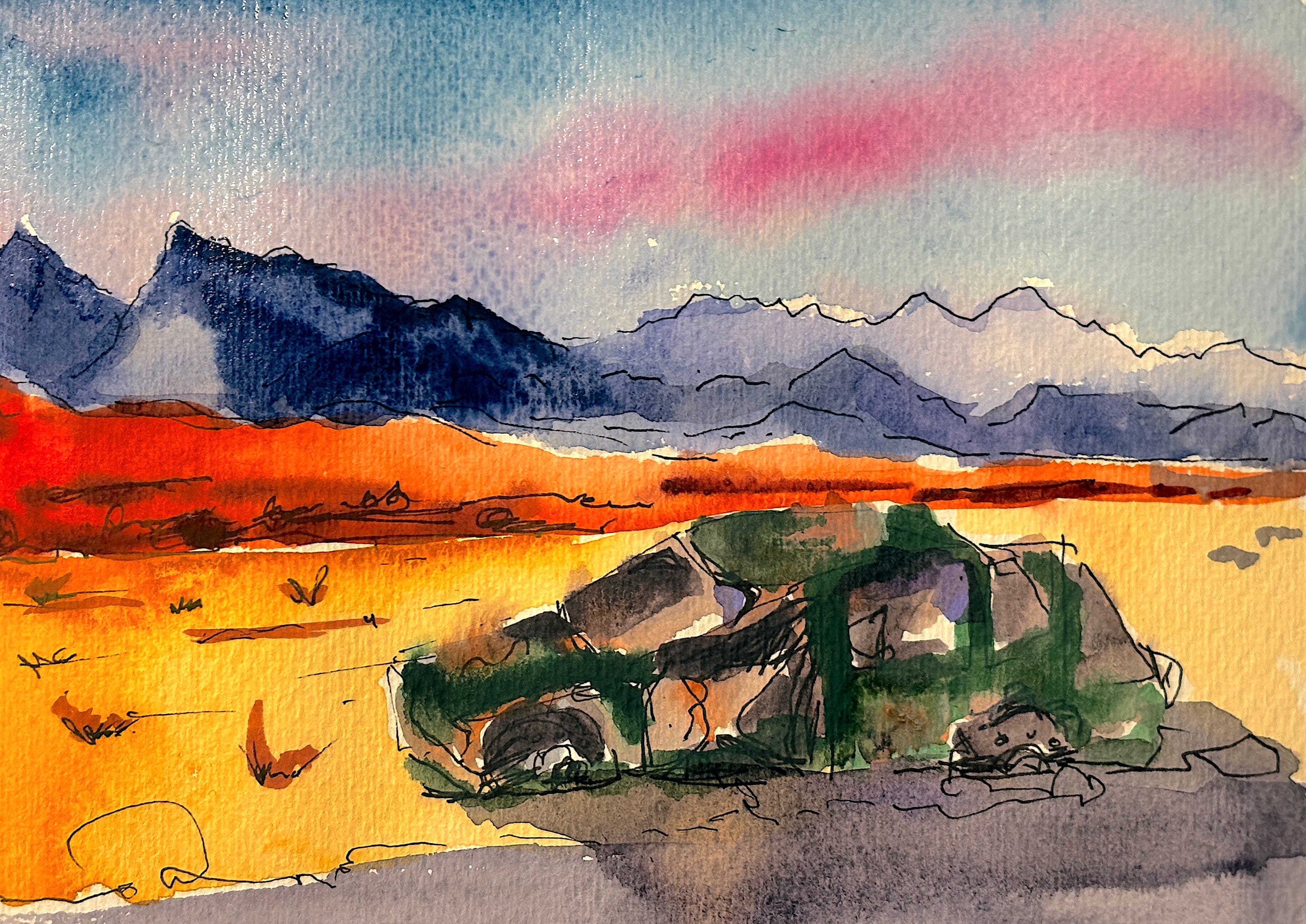
It’s then that I see two sedans, one black and one white, circled around each other on the side of the road like yin and yang. The white car’s bumper cover is freshly ruined. The sedans have just had an accident. I wonder if this has pushed them one step closer to that craziness I’m so familiar with. Their driver-side windows are next to one another, and I can see for a brief moment before I pass that each driver stretches out their hand to touch the other’s in a handshake, or a high five, or some other gesture. Whatever it is, it’s a peace offering. Every time I’ve participated in this little ritual, it’s been while standing outside the car, stepping out into the world for a moment before slipping back into the coffin. But these two, beside me now, connect in a moment of reality and true personhood from within their cars. They don’t submit to the crash but stretch out toward the humanity in front of them. There’s beauty in that moment of doing everything they can to be connected; it’s a strong image of compassion and decency. How close can they get to that personal connection while remaining fully in the car? They have options: a longing hand pressed against the window, a silent mouthing of words through the glass, a voice pleading for a response through a cell phone, a recorded message playing over a car’s speaker. Each of these methods puts a bit more distance between the people involved, but aren’t they all the same — in spirit, at least? It requires the same effort out of a person’s soul, and to my mind, loses none of its meaning or beauty. The motion is identical: you feel the warmth of someone else’s hand holding yours tight to keep you from chasing after the final crash, and you can float in the unbelonging unalone.

*Our essays are always online and always free, but we rely on individual donors to keep The New Critic alive.
Postscript, our interview series, can be accessed with a paid subscription. The $30 annual rate costs as much as a couple paperbacks or movie tickets. Our $250 founding members are our most ardent patrons, those who wish to advance our wildest editorial ambitions.
If you read The New Critic and take delight or solace in our project, please consider a paid subscription to this flesh-and-blood gen z magazine.*
THE YOUNG AMERICANS
 | A guest post by
|
Such a strange story, and so well written! Loved this
I've been waiting for this one...