

American Berserk
“It was always fucking Willie Nelson around here. Carl hated the Palestinians. He loved organic farming. The man contained multitudes.”

THE NEW CRITIC
Samuel Rigg is a 25-year-old writer living between Oxford and London. He is most recently the author of “At the Rink” and attended the University of Oxford for his BA and MSt in English Literature.
“Wait a minute,” Richard said, standing up. We were gathered at a table by the pool and had been speaking about the Civil War. I was 18. He was in his late eighties and was impressed that this English boy, who was visiting the United States for the first time, had accrued so much knowledge about the war. He came back five minutes later, his hand cupping a collection of trinkets. There was a musket ball and a rifled bullet — an archaeological history of military development in two objects. There were also — the objects I was most taken with — a number of brass buttons on which the Union Eagle was still emblazoned.
“They’re for you,” he told me. “We have loads of the things. People come detect on our land and give us a share of their finds.”
Almost 40 years before that August afternoon, my mother had spent a summer with Richard, her cousin’s in-law, and his family. For one week, Richard took her along with him on his errands. He was Associate Chief of Protocol at the White House in those years — a kind of presidential advisor when it came to matters diplomatic. My mother told me stories of how they rushed through D.C. together, going from one appointment to another. They spent time in book-lined offices and wood-panelled bars. The conversation all around them seemed to hover on another plane to her 18-year-old ears. Richard and his conversant would swerve between subjects, resolving whatever they’d been haggling over — another salutary glass drained, another cigarette butt ground into an ashtray. She told me about these things and they seized me, of course. This was the Imperium. The Potomac wound its way, swollen and green, through the capital. Marble buildings shimmered above the heat.
Richard’s granddaughter, my distant cousin, took me to see Richard and his wife Elizabeth in 2019. Whatever conception I had of America was in many ways already defunct then — if it had not always been a fiction — but for my naïf self there was no doubt that the pollen of the Pax Americana still clung to the edges of things. I remember the country before we got to their house, the wind cutting through the fields of tall grass like something rushing through the undergrowth, the picket fences bracing the incline of the landscape. The grasses would stop, and turn, and bend in another direction as the wind dropped and then gathered force once more. There was a hard, high sun. Light and shadow played in the rippling fields, while the two-lane blacktop unrolled before us.
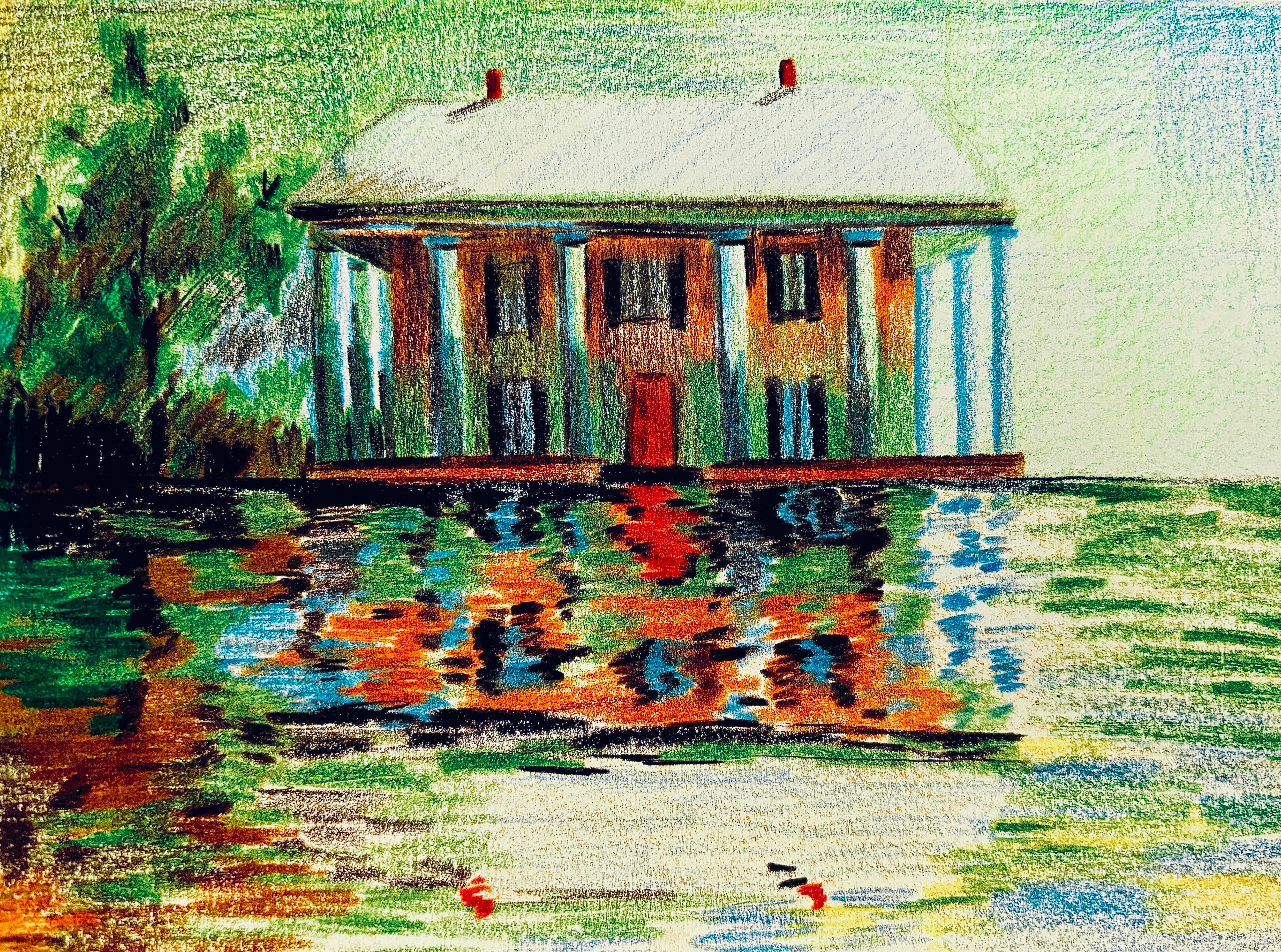
We came to a long avenue of oak trees planted during Reconstruction and slowed. Branches chattered. Even with the breeze, it was hot. I remember the car swinging around the oval drive to reveal columns floating up to a pediment two stories above. Black clapboard shutters were closed over rows of high windows. We stopped round the back of the house, but Elizabeth insisted we come through the main doors.
She was, as I’d expected, an elegant woman, with long, patrician fingers that clutched my hands when making introductions. She had a slow, Virginian voice that wasn’t hurrying for anyone. In her case especially, all the clichés seemed apt. She called to her husband, “Richard, get down here, the guests!”
We heard his tread on the landing, and he came calmly down the stairs. He shook my hand and kissed his granddaughter. Elizabeth now stood with her husband, a tall, handsome man 10 years her junior, in the grand entrance of the house.
In the dining room, the walls were covered with French wallpaper from the 18th century depicting various stages of the hunt. There had been a fire 20 years before in which the interiors of the house had been ruined. Afterwards, Elizabeth and Richard had gone to Paris in search of the original paper. They found the last remaining sheet in the city and paid a small fortune for it.
“Some drinks?” Richard asked. “Wet or dry?”
“You’d have liked the parties we used to have here,” Elizabeth said to me, smiling with remove as she led me into the garden. Having her attention felt as if I’d been elected in some way. It wasn’t that she fixed me with a stare or anything so commonplace. It was something else, something to do with being able to talk to her at all. We found shade beneath an elm and carried white wrought-iron chairs across the lawn. The party grew. Elizabeth’s daughter and son-in-law strode out to meet us, their black labradors following with lolling tongues.
The ground sloped away from the garden and rose again in the distance. The dogs rolled on the grass. This was where the first skirmishes of the Civil War had taken place: 100 miles from Richmond and 50 from the Capitol. The nearby Rappahannock River formed a natural boundary for the Eastern theater of the war. This was real country.
There was an old tennis court on the property, its gates rusted, its fences overgrown with lush greenery. And there was a pool, of which I have a photograph. It holds clearly in my mind anyway. A limpid blue with the summer tones of the fields just behind it. Elizabeth still played tennis and swam, my cousin told me, looking at her grandmother. That lunch, she kept on checking we were all filled up and satisfied. I sensed she was measuring us against those whom she had known in times prior. Later, she took us for a drive in her buggy, driving rapidly: “Hold on.” She took us to the site of one of the last duels in Virginia, which had taken place in the summer of 1881.
The house she and Richard lived in had been finished in 1933 on the site of an older structure. Built in the Classical Revival style, the money for the building had come from Elizabeth’s great-grandfather, an oilman and rail tycoon worth $25 million at the time of his death. The capitalist’s daughter had commissioned the great house (as well as two others on the same land) for her three daughters after the death of her husband. It was here, “in the colonial church down the road,” that the husband was buried. “She was too old to change her life.” Elizabeth was the last of the great-grandchildren — this was what she told me. There was no ellipsis in her speech, no circumlocution; she laid the facts out plainly, in the words of a woman raised in the South during the earlier decades of another century.
She spoke about what America was becoming with horror — not with snobbery but with despair. She said that neighbors were beginning to demonstrate their hatreds openly, that the old demons were returning.
Elizabeth lived to be 101. There was a great party thrown for her hundredth. She did not know what would happen to the house after she was gone. I can’t say she seemed to care.
The autumn I went to Fletcher, North Carolina, things in my own life were more complicated than they’d been when last I’d visited the Southern United States. For one, university was behind me. More significantly, I was in a relationship with a girl whom I loved more than I’d ever thought possible but with whom, undeniably, the complications seemed to be mounting.
I had come out to The States for three months. My girlfriend and I had spent the first-half of the trip together in Chicago and New York, and I’d planned the latter-half as a writing retreat. She was to briefly join me in North Carolina before flying back to the old country — to her Italian grandparents, to culture, to cooking, and to everything she missed. We were to stay in Fletcher with Jane, a family friend, and her new partner, Carl.
“They are great people, really warm and kind and generous. You’ll love them,” I told her as the taxi took us toward the house. She was suspicious. In truth, I thought her trepidatious attitude somewhat unnecessary. Her own father was from the South — deep; Louisiana — and her ambivalence toward this part of the world was definitely affecting my perceptions. Trying to stave this off, I’d spent the last couple of days reassuring her how wonderful this part of the trip would be. But I’d failed to imagine what coming out to live in this place might do to a person — what that old American berserk might make you do. This berserk was of a peculiarly European stripe: like Kurtz, or Andrew Jackson — I knew the signs. What might it have done to the two we were going to stay with — two previously suburbanite Californians? I hadn’t yet considered what it might do to me.
On the afternoon of our arrival, I looked at Carl as we drove to the store to buy a few steaks. I really took him in for the first time. He was the proper American man. He wore a “Monsanto are scum” shirt over his tensile body. He was bald and a great hunk of muscle and looked like he was always grinding his jaw — as if he could snap at any moment. He shared an undeniable likeness with the turtles he’d been telling me about. He was humming along to Willie Nelson on the radio. It was always fucking Willie Nelson around here. Carl hated the Palestinians. He loved organic farming. The man contained multitudes.
At our steak supper, Carl returned to his favourite topic: the problem of the snapping turtles. “The things are vicious. Can break your finger off like that,” he said, snapping his fingers to illustrate, “if they get a grip on you.”
He told us how his dog — a traumatised pit bull named Roxanne — had been barking at something through the garden fence and wouldn’t stop. Carl had gone down to take a look. There the thing was at the edge of the long grass, a fitting nemesis. Carl strode off. When he returned, he held a silenced pistol. The dog was still barking. The turtle was crouched in the grass like an emblem of brutish nature. He took in the scene, and then he unloaded a full magazine into it.
My girlfriend squirmed beside me. Our sensitive European attitudes were at a loss. “It’s amazing how much lead those things take,” he said, chuckling.
The next morning, I woke to a great commotion taking place outside the bedroom window. I felt like I’d been punched in the face. All limbs and sleep, I moved outside to find Carl standing next to a parked truck, its tailgate open, with a massive safe sitting in the bed. He looked extremely irritated with the two men who had been endeavouring to move the thing.
“Well, next time make sure you bring the right fucking equipment to get it off the truck,” he said, shaking his head. Then, he saw me. “Hello princess, sleep for long enough did you? I was half-tempted to come into your room and start fiddling.”
I registered that he was talking about his instrument and was marginally relieved.
“What’s this safe for?” I asked, ever the innocent.
“What do you think, dude? The guns!”
I looked at the safe again. “Does it need to be that big?”
“Well, I have 60 guns, and the woman wants something impenetrable.”
So the gun obsession was real? Very well, then. Soon, I was going to be alone with Jane and Carl. Jane was close to my family; I really was fond of her. But I was perplexed by this recent choice of partner; his disposition was a long way from her former husband’s, though they both worked in real-estate development. Jane’s father had been in that industry too — so she had something like a type. Anyway, I felt I was ready to lean into all this, to the hospitality along with the guns, to the general weirdness. It was incredibly kind of Jane and Carl to offer for me to stay with them, though the incredibly generous, I was beginning to discover, had other eccentricities.
After my partner left, slightly disturbed, there was a new topic of conversation.
“In the Southeast, it’s supposed to be the mother of all storms,” Jane said. She was hoping that things would pan out in such a way that Carl wouldn’t be made to demonstrate his prowess. When she looked at me after one of his soliloquies I could see the plaintive look in her eyes: pray that there will be no need for any antics. Carl was overbrimming with competence. They were talking about the coming hurricane, but Fletcher was only supposed to pick up its outer perimeter. Carl said we were ready; he was actually kind of looking forward to it. He’d checked his generator, and it was working like a dream. It would be responsible for powering the electric water pump and other critical electrics. He’d stocked up on a few extra bottles of water at the supermarket in case of a real emergency. And his Toyota FJ was decked to the nines — it had every kind of extra gadget one could imagine. In sum, a certain American bullishness pervaded the house on the eve of Hurricane Helene; by God, we would see this thing through come hell or high water.
Now, I’d be lying if I claimed I wasn’t already filled with a dreadful sense of foreboding. I could feel that something wasn’t quite right (in the air, in the fact that neither of them drank any alcohol). Despite the lateness of the season, a heavy, muggy feeling clinged on in the valley; I felt it was choking me. I was ready to flee to the towers of New York and give up on my writing retreat.
Part of what first drew me to the American South was a persistent interest in the Civil War. I made sure to visit the battlefields of Gettysburg and Bull Run, but further, I was — in a manner of speaking — haunted by certain figures, my heart with every Northerner’s favourite, Union General William T. Sherman. When I’d first read about Sherman and Ulysses S. Grant, I was drawn to their heroic element, drawn to their capabilities as commanders and their tactical expertise. It is, I think, a common-enough phenomenon among boys and men that it barely needs analysis. One will never have a day as important as when Sherman forced Confederate surrender at Bennett Place; given this, these imagined historical acts themselves become places in which the mind can live.
Sherman burned his way across the South. He destroyed it. But he was also given to sentimentality: when he resigned from his position at the Louisiana Seminary, he held his heart and said simply to his cadets, “You are all here,” and then turned about resolutely and left the room. Sherman had failed in his previous work as a banker in San Francisco; he was depressive, even suicidal for a time. War was the thing he had a competence for.
If I was first drawn to their heroic element, with time their contradictions have become the main attraction — Sherman and Grant seen as embodiments of particular kinds of failure. Before the war, Grant had, like Sherman, lived an unstable life, drifting between various failed ventures and in the end going to work for his father’s business. I’m attracted to the ways that the war appeared to redeem them both, which is itself, of course, another sort of half-truth.
With the invasion of Ukraine, I knew of young men, peers of mine, who rushed off to the country as soon as term ended. They wanted to volunteer with charities, and they also wanted to be as close to the front lines as they could get without actually fighting in the war. These men — boys, really — were stoners at university. They’d drifted around, reading books like Tom Wolfe’s Bonfire of the Vanities and Christopher Hitchens’s Letters to a Young Contrarian — then they went to Ukraine to make pizzas and drive delivery trucks. The decision to go and help was noble, regardless of its origins.
I ask myself now whether by reading the memoirs of Sherman and Grant I was getting an even more abstracted version of the feeling those young men had — without, of course, any of the moral benefit or usefulness. Perhaps reading Sherman’s letters filled me with false purpose. When will one ever have a day as important as one of his? Sherman was manic, but in his instance the mania seemed appropriate, whereas some of us are merely manically drifting.
In truth, there was nothing romantic about Sherman’s tactics. He and Grant were the first generals to, in Grant’s words, “believe in the war.” By that, Grant meant that the Union generals before them were merely playing along, seeing it as a kind of gentleman’s agreement or an opportunity for adventurism. These two, on the other hand, knew what it would take to bring the traitors to their knees. Though neither man held strong views on slavery initially, it was, in the end, their military strategy that facilitated its abolition. Perhaps some of us now are simply sitting, waiting for the kind of convulsion that would make such grand gestures possible. In the meantime, jets scour the skies of the Middle East and I watch the oil prices rise.
Hurricane Helene was far worse than had been expected. I woke in the night, knowing instinctively that the power had gone. I could hear the wind ratcheting up through the trees and was half-conscious of one of them coming down. And yet my nocturnal conception of the storm was nothing compared to the scale of destruction visible come first light. The creek, usually 21 feet below the house, had risen to the foot of the porch. Everything — fenceposts, cars, livestock — came sweeping through the valley, taken by the flood.
On the second day after the hurricane’s destruction, a neighbour stopped by Carl and Jane’s house. His speech was brilliant. He was ancient but lively, and he said that this was the worst storm since 1916.
“You see, there was this tree trunk we always tied the horses to when they was feedin’. And you knew if it was a bad flood ‘cause the water came up to the trunk. This one the water went all the way up past the trunk, went way past that. Way high up.” It was as if he could remember those prehistoric storms and compare them…
From conversations I had with the neighbors over the following days, I heard about the destruction in Asheville’s Arts District, how double-wide trailers on hillsides had been swept away by the river, how whole families had been killed.
The generator, Carl’s pride and joy, didn’t work. We went out in the Toyota together, hoping to find a way through all the downed wires and pines. He’d suffered the onset of Bell’s palsy during the night of the storm, and his now half-drooped face looked determinedly ahead on strewn and flooded roads. We sat in the car and watched brave workers skilfully wield chainsaws high up in the canopy, but it was all going to take days. So we drained water from the pond in order to flush the loos. We diligently rationed bottles of water while the dirty plates stacked up in the kitchen. Carl cooked his defrosting venison — hunted the previous autumn in Montana — on the barbecue; it was to be our lunch and dinner for the rest of my stay. Somehow, he had intermittent cell service, which he primarily used to contact a friend in Detroit. His friend seemed to be sending him regular, unreliable updates about the situation around Asheville. He warned Carl that the Mexicans were busy looting houses in the area. It was exactly the kind of paranoia I had thought was a stereotype (but then, the presidential elections were in November). While he slept, Carl kept a rifle by his bed. I would sit for hours down below, smoking Camels on the porch and looking at the distant hillside — usually speckled with lights — now blanketed by the dark.
It was a week or so after the hurricane hit that the wires on the roads were cleared, and Jane and I finally made it to Asheville. On the way, we saw families who’d lost their homes crowded in the backs of flatbed trucks. The National Guard, too, was now out in full-force; Biden had granted the state governor his request for a Federal Major Disaster Declaration. The extent of the damage was impossible for me to comprehend. It looked like the mess would take years to recover from.
In Asheville, volunteers were making food in the centre of town, and I sat with a couple — both in their sixties and both psychoanalysts — in the street. They had moved from New York 20 years earlier. The man talked about how here gentility and friendliness always had an edge; in New York he had driven taxis and had grown used to the hurly burly of honking and shouting. In North Carolina though, “You know that along with that smile there’s a gun waiting in the back of their car.” After a while, another man came to join us, greeting the couple warmly. Hearing where I was from, he said he’d been in the American Air Force and stationed in Oxfordshire during the Cold War. He talked of frigid mornings waking in the old dormitories of the school in which they were based, of readying jets for the skies of Western Europe, the mist lifting over the runway. Listening to him talk, I felt his longing to be back there and away from the verdant, mountainous, and humid country in which we found ourselves.
After the storm, Jane’s son drove straight from Dallas with two mini-generators and gallons of fuel in his trunk. To welcome his arrival, the alcohol — a single bottle of wine — was finally brought out. During the day, we began to clear the property of debris, locating stray stakes from their twisted fencing. The son and I spent an afternoon burning collected brush in a huge pile; we filled empty soda cans with fuel and tossed them onto the growing blaze, inducing grander and grander explosions. Chinook helicopters passed overhead and Creedence Clearwater Revival played off the car radio.
Finally, a limited service began running from Asheville’s airport to Manhattan. Ten days after the hurricane, I boarded a flight back to the city. As the plane rose above North Carolina, the full destruction became visible for the first time. Miles and miles of havoc diminished beneath me, the world becoming a toy town of waking consciousness. I thought reflexively of the destruction that I knew Sherman had wrought on the South. The destruction I saw below was not the result of a travelling Northern army, but it was the closest I’d ever been to seeing something like it. It was also not some abstract notion of historical events but something that flesh and blood and breath were still living through. This was happening, and I felt guilty. I felt guilty for leaving, for being someone who could board a plane and go and who did not have to feel the full effects of the thing they’d supposedly been present for. But it would be dishonest if I didn’t say I was also relieved to be going. When the plane dropped down to the height of the skyscrapers, nearing the runway at LaGuardia, I put on Leonard Cohen’s “First We Take Manhattan.” I let myself relax for the first time in weeks.

*Our essays are always online and always free, but individual donors keep The New Critic alive.
Our $30 annual subscribers get access to Postscript — new weekly installments and the complete archive of our gen z interview series. Our $250 founding members are TNC’s most ardent patrons, those wishing to advance our wildest editorial ambitions.
If you take solace or delight in The New Critic, this flesh-and-blood gen z magazine, consider subscribing to support our work.*
THE YOUNG AMERICANS
 | A guest post by
|