

All of Russell's Men
“I also worried about conferences full of those who eat the cake of Christian morality whole.”

THE NEW CRITIC
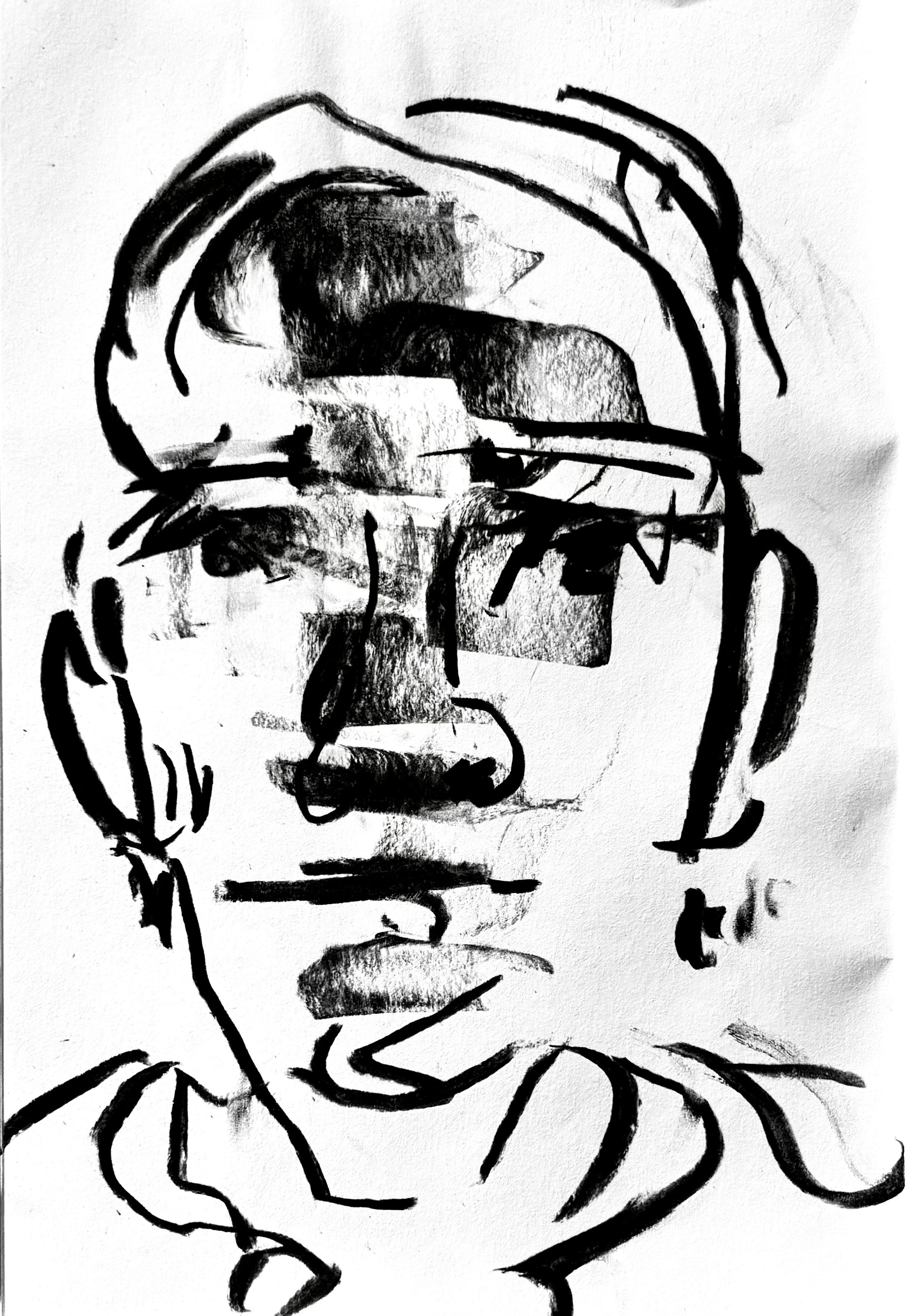
Elan Kluger is a 22-year-old writer and editor of The New Critic from Michigan studying intellectual history at Dartmouth College.
Mecosta, Michigan is almost inaccessible to peripatetic elites — and that is how Russell Kirk liked it. The conservative political theorist did not take kindly to the coastal beau monde jet-setting into his city. Lacking even a driver’s license, he called the car a “mechanical Jacobin.” Kirk made his home in that leafy village, but nowadays, you need a mechanical Jacobin to get to Mecosta.
Some months ago, a conference on the American Political Novel returned me to the Midwest. More specifically, it was a conference on the alleged “greatest” American Political Novel, All The King’s Men by Robert Penn Warren. I had signed up on a lark. All The King’s Men is a book one is said to always be “rereading” but for me remained unread. The Russell Kirk Center in Mecosta hosted the conference, and though I’d grown up in nearby Ann Arbor, I’d never visited the Center. Attending this conference was like killing two birds with one stone or, rather, — given the conservatism inherent to the southern novel and to Kirk — killing two bald eagles with one AR-15.
My run-ins with conservatives began en route to Mecosta. At the Newark airport, I stood behind some young Orthodox Jews during security and waited anxiously as the guards asked them to take off their large black hats — I imagined that this would trigger a duel between Judaism and modernity. Hashem says I cannot take off my hat, little Yehuda would say. We need you to take that hat off for security reasons, Miguel the TSA agent would say. I was mistaken. Little Yehuda removed his hat because he had a black kippah underneath. He had planned ahead.
On the flight, I considered asking what these yeshiva bochurs were planning on doing in Grand Rapids. What does anyone do in Grand Rapids? What does anyone do in Michigan? I thought back to Saul Bellow’s Yiddish-language encounter with a Hasid in the opening pages of To Jerusalem and Back, where the startled Bellow tells of a man who had never heard the name Einstein in his life, nor heard of mathematics. I was not granted such an interlocutor — my safety exit row companions were two large men who I didn't think would be of help in the case of an emergency. (They dozed.)
I met two others who would drive up to Mecosta with me at the Grand Rapids airport. One had thick, wire-framed glasses, replacement teeth, and a body drenched in sweat, even though the airport was well air-conditioned.
“I learned a new word from the book,” he divulged to me within five minutes of my meeting him.“Picaninny.”
“What does that mean?”
“A small nigger,” he said with glee.
“Okay,” I said and turned to the other guy. He was brown, tall, thin, and wore a button-down that I read as tasteful and expensive. He was the only other secularist at the conference and had flown in from Washington, D.C. where he worked as a journalist. We bonded over our shared religion of literature and spent the next thirty minutes talking about Martin Amis and Bellow.
As we drove into Mecosta, I mulled over how dull life must be there. Perfect, perhaps, for those with a narrow, religious frame of mind. One bookstore, one ice cream shop doubling as a hot dog stand, one gas station — a masterable, empty town. There was more culture on my block in New York City than in the entire thirty-mile radius surrounding Mecosta. In the city, each day I could go to a new bookstore, new bar, new art house theater, and talk to new girls. New York was endless and endlessly enriching. Mecosta was tedium and sameness. I steeled myself.
I was new to Mecosta but not Russell Kirk. I had flipped through some Kirk in the ninth grade, as a counterpoint to my youthful fascination with William F. Buckley. I interpreted Kirk as too dour and too grumpy. Every photo of him exhibited a scold. He was someone equally enraged by modernity as by the kids on his lawn. The effective but merciless portrayal of literary critic James Wood was more apt for Kirk: he seemed like he wanted to be his own grandfather. His books were replete with references to T.S. Eliot and Edmund Burke, figures who, even in my bibliophilic youth, appeared too fusty and passé. And I also suspected that Kirk didn’t like Jews.
Kirk’s wife, Annette, provided a more textured portrait of her deceased husband when all the conference participants arrived. Kirk had worked as a literary critic and political commentator, forever on the margins of the American conservative movement, writing book after book in the hopes of rehabilitating the old-fashioned and rather unstylish tradition of British conservatism. Controversially, he did not relocate to D.C. to enter the rat race of political influence. His was the heartland conservatism of continuity, not the neoconservatism of the urban, uprooted elites in New York and D.C.
The generous funding for the conference came from figures that shared his mission, which at its best, emphasized local living, Christian values, and the maintenance of tradition (the “permanent things” as he called them). Russell Kirk’s house was one of those permanent things, and we gathered there for our opening dinner. The Kirk Center had renovated the creaky mansion to ensure it looked as it did many years before.
Before the opening dinner, I conversed with a rather dapper middle-aged magazine editor. He always had a cigar and scotch in hand and was generous in offering both to others. He shared with me that he had just relocated to rural Tennessee from Chicago because of high costs and high liberalism. When he inquired about my profession, I informed him I was a Dartmouth student. He said he attended the nearby Middlebury College many years ago. “The woke have captured it since then,” he said. I smiled. He sensed I was a willing listener and launched into a tirade.
“Contraception used to be universally condemned and banned. You could not suggest otherwise in polite society. Now you can’t condemn it. Abortion is going through that same change. I don’t believe that this is progress. This is decline.”
“Perhaps God is a progressive?” I asked. “Maybe this change in social preference is what He wants? Isn’t the true the actual?”
“Have you been reading your Bible?” he responded.
“I must confess,” I said. “I’m behind. Too much great literature,” I smirked.
“That’s fine,” he said. “But remember the Hebrews are punished for disobeying God. For going off-course. And that is what we are doing. In no way is this world of free love and contraception and abortion and homosexuality the will of God.” Then he added, “Read The Abolition of Man by C.S. Lewis.”
I grabbed another beer and struck up conversation with a stiffly dressed state university professor named Steve. He had once been a left-winger and had dropped out of college to sing in a rock band. He showed me a video of his band. I was stunned. Steve, currently bespectacled and awkward in the same manner as the protagonist of Whit Stillman’s Barcelona, was as far as one could get from the long-haired radical in his video. He played a song his band had written for Nancy Reagan’s “Just Say No” policy towards drugs. (Of course, the entire band was high all the time, even in the video.) “Now I’m into the permanent things,” he joked.
Rock money dissipated, and Steve metamorphosed into a comparative literature professor, dutifully writing a dissertation on the socialist novels of the 1930s. Like most of the professoriate, he was a thoroughgoing leftist and read the books one reads and had the opinions one has. He even spent a sabbatical in Zuccotti Park, occupying Wall Street: true praxis. But the Charlie Hebdo massacre, when Islamist gunmen murdered defenseless cartoonists, altered his views. He recounted the debate between famed cartoonist Art Spiegelman and Professor Tariq Ramadan on Democracy Now, a show he loved. Spiegelman was on the defensive in condemning the murder. Most of Steve’s friends and colleagues judged the murders just. Steve snapped. Even as he spoke with me, his mild-mannered demeanor began to flair. “They defended murder,” he said. “And my wife is a cartoonist. That could have been her.”
The Charlie Hebdo attack and aftermath ensued concurrently with his slide into spirituality. Steve was a recovering alcoholic, and he had long been a seeker. He soon located a parish that matched his desires, and he began to direct the Spanish-language service for new immigrants to his city. He also presided over Alcoholics Anonymous meetings in Spanish, as well as German and English.
The conversation turned from alcoholism to Heidegger, as all great conversations do. Steve had relocated to Germany in his twenties to learn German and read the great philosopher in the original. But in recent years, when Steve turned to Catholicism and conservatism, he discarded Heidegger. “Have you read those infamous sections of The Black Notebooks?” he asked me. “Where Heidegger unrepentantly defends Nazism?” I said that I had.
“How can you still read him?”
“I’m Jewish,” I said, “and not only do I read him, but I read him with delight.”
Steve said he intuited in me a certain romanticism. “Too much Rousseau and Novalis,” he said. “Sentiment is an important part of being human but ought not be a religion.” He prescribed Irving Babbitt’s Rousseau and Romanticism as a treatment for my strange affliction.
“If you can read that and remain a romantic, I will be impressed.”
“Challenge accepted,” I said.
Dinner time came and I maneuvered for a seat next to the conference leader. He asked the table a question that seemed like his practiced refrain because of how easily it rolled off his tongue: “What is your favorite metaphor for the Trinity?” I tried to hold in laughter while the two Hillsdale Catholics next to me jumped at the chance to impress the man with their religious imagination and fervor. I sat in awe that anybody cared. (But isn’t inspiring awe what the Trinity is meant to do anyway?)
Later that night, over scotch, I spoke again to the fellow I had met at the airport — Mike, the one who had greeted me with his knowledge of a new slur. In the more relaxed confines of the horse ranch the Kirk Center had put us up at, he recounted his life story. I had thought he was student-aged, perhaps twenty-two or twenty-three. He was still a student — he was finishing up an online bachelor's degree in theology at Liberty University — but he was in his late thirties. He had started college at CU Boulder years before but had left after a suspension for dealing weed. The rest of his troubling story involved the suicide of his brother, the overdose of his girlfriend, violent encounters with other drug dealers, and jail time for animal cruelty (in a moment of fury, he shot and burned his father’s three bullmastiffs). Mike assaulted a guy following his release and was then returned to confinement for an unknown period of time. A fellow inmate gave him a Bible, and he drank in both inspiration and explanation from the text. He promised God that if he was set free from jail, he would devote the rest of his life to divine service. The next day, Mike was free.
For the two days of the conference, we awoke for breakfast at eight, far too early after a night of drinking. We then carpooled the short drive to the Kirk Center’s library. We gathered around a seminar table positioned between the well-stocked shelves of political theory, literature, and history. Everyone presented a 250-word paper on an assigned chapter each day, and then we all would weigh in. We would break, eat lunch, walk around Mecosta, then return to the seminar. Dinner, drinks, and then sleep. These were full days.
A lanky, late-middle-aged Southerner presided over our discussion, instructing us as if we were high schoolers. (I later found out he primarily taught in preparatory academies.) He gave general writing feedback on the papers after each session. His advice was either obvious or obviously objectionable: he counseled using stronger verbs and eschewing the first-person pronoun. I dissented. And in the discussions, he echoed every comment that approached wisdom with, “I thought that, too.” I don’t like teachers that are competitive with their students.
All The King’s Men is, thankfully, a rich enough novel to shimmer despite foolish instruction. It is a story with two textured characters: Willie Stark, a fictionalized version of Depression-era Louisiana Governor Huey Long, and Jack Burden, a sour man who concluded coursework for his PhD in history at Louisiana State but succumbed to writer’s block on his dissertation and became a political reporter. Willie Stark’s charisma lures Burden, and he becomes the governor’s fixer, as well as witness and narrator to the legendary populist’s rise and fall.
While critics classify the book as a “political novel,” Willie Stark and his travails are not the novel’s focal point. In fact, it’s not a formally political novel at all, but rather the story of the moral education — or, more accurately, the miseducation — of Jack Burden. Burden crams his narration with harsh observations and judgments — what I took as his wit and his charm. But the conference participants were not so enamored. One participant observed that Burden only dispenses slightly cruel descriptions, even of the people he loves.
The difference between secular and Christian exegeses of the novel came to the fore especially in a passage where Burden recounts almost having sex with his dream woman. My interpretation, and that of the only other secular participant, was that Burden deliberately avoided having sex to maintain his fantasy. The rest of the participants argued otherwise. One pointed us directly to a quotation from Jack: “‘We oughtn’t — it wouldn’t — it wouldn’t be — it wouldn’t be right.’ So I used the word right which came to my lips to surprise me….” According to the other participants, this was Jack beginning to learn the language of justice, of what he ought to do. It was Jack’s conscience awakening. Only the Christians sensed that.
In their short papers, most of the faithful supplied accurate but dull recitations of the novel’s themes. Why does Jack scurry to California when he is heartbroken? Why does Stark recruit Jack’s friend to run the state hospital? I listened to their papers and nodded along, but I found myself involuntarily reaching for a book, or even, God forbid, my phone.
In treating others as I like to be treated, I endeavored not to bore in my responses. I yearned to shock, to startle, to awaken. I wrote a short paper titled “In Praise of Ignorance” declaring, “Burden seeks to know about Judge Irwin, and in knowing of rather rotten political deals he had made in his youth, he un-knows and un-learns.” At the end I proclaimed, “Let us now praise ignorance.” An elderly Catholic lawyer, apprehensive about my unqualified statement and youthful bombast, floated a title change to “In Praise of Jack Burden’s Ignorance of Judge Irwin’s Past.” I rebuffed him and quoted Richard Hofstadter, that “if a new or heterodox idea is worth anything at all, it is worth a forceful overstatement.” Everyone laughed and the discussion continued on.
At the going away dinner, a woman told me that she was perturbed by the young men she chanced upon at other conservative programs. They seemed enthralled by fascistic impulses. They were all well-groomed and polite, but they gave detached smirks when the conversation turned to political and moral commitments and preferred to tarry with their love of war and adoration of strength alone. She told me she was relieved that the Kirk Center studiously avoids those types. Mecosta’s rurality, Kirk’s faith, and the slowness of literature sieves out young Alexanders. I agreed. I told her I had come across such young men as well, although I often was more amused by them than frightened. But, I added, I also worried about conferences full of those who eat the cake of Christian morality whole. Surely that wouldn’t attract the brightest group of people?
With time to think on the flight home, I weighed the Christians I encountered in Mecosta against the ones I met in New York or at Dartmouth or elsewhere. The conservatives I was accustomed to meeting were religious only in identification. They were as disintegrated and bereft of doctrine as the next secular student. All that distinguished them was that they explicitly affirmed a metaphysical doctrine either as comparative advantage in the job hunt or for surreptitious political motives or because conservatism on campus is subversive and they wanted to gather where the fresh ideas are. If patriotism is the last refuge of scoundrels, political reaction is the last refuge for those who are not utter dullards.
I recalled, at a separate conference, a Yale Catholic conservative who explained that Protestantism, as it taught the world to read the Bible, had released an unintended secularizing force on the world. Literacy is the enemy, he told me, because literacy leads to questioning the order of things. I thought it was a just-so story that ended with his friends as the czars ready to rule and the masses hungry to submit. (Just a religious tilt to modern banking.) I suspected his religiosity and his sincerity; he was just roleplaying tyranny. The language of conservatism, long marginalized in elite institutions, allowed him to shock those he took as naïfs.
But the Christians of the Kirk Center were new and novel to me. They experienced the world as one where good and evil were real, observable, and worth fighting through action and faith. The best among them took this as a mandate to act in good charity towards all. While I sat in the library reading a Milan Kundera sex novel, they discussed man’s fate. They could face the boredom of the small town with a soul in repose. They grew tired by the end of my quips and observations and found in them an excuse for my lack of moral commitment.
At the end of the conference, a Michigan state senator went to the local bookstore, bought Saint Augustine’s Confessions, and signed it for me. “Make me chaste, but not yet,” I quoted from memory, then laughed an ironic laugh. He laughed too, but then he frowned. I had much to learn.

THE YOUNG AMERICANS